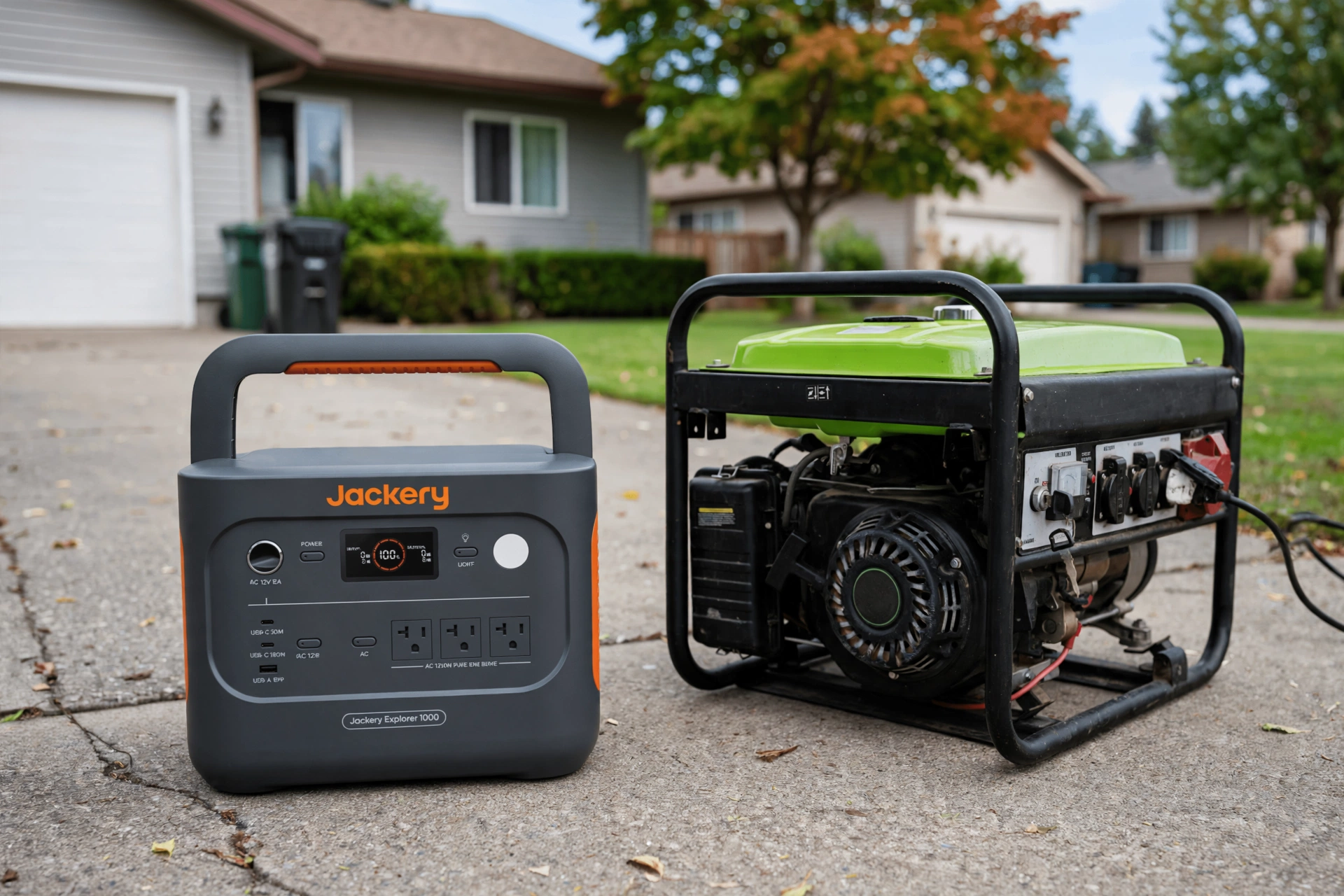
Portable power stations and portable generators both give you electricity where the grid does not reach — but they do it in completely different ways, with different trade-offs in noise, cost, maintenance, and what they can power. Picking the wrong one is an expensive mistake, so this guide lays out exactly how they compare and when each one wins. No lab testing here; this is a straight technology comparison based on how both product categories work.
- How each one works
- Power output: the big divide
- Noise
- Cost: purchase and running
- Maintenance and lifespan
- Indoor and campsite use
- Fuel, fumes, and environment
- When a generator wins
- When a power station wins
- Frequently asked questions
How each one works
A portable generator burns fuel — gasoline, propane, or diesel — in a small engine that spins an alternator to produce electricity. It generates power on demand for as long as it has fuel. A typical 2,000W inverter generator runs 8–10 hours on a gallon or two of gas.
A portable power station is a big lithium battery with an inverter and charging circuitry built in. It stores electricity (charged from a wall outlet, solar panels, or your car) and releases it silently. A 1,000Wh station holds about as much energy as a laptop battery scaled up fifty times — enough for a night of devices, not a week of appliances.
The core trade-off: generators make power continuously but noisily; power stations store power silently but in limited quantity.
Power output: the big divide
This is where generators dominate. A mid-size portable generator delivers 2,000–3,500W continuously and can surge higher — enough for a full-size refrigerator, a microwave, power tools, or a window AC unit. Larger portable generators reach 7,500W+, covering most of a home’s essentials.
Portable power stations top out much lower. Mainstream units deliver 1,000–2,400W; even the largest consumer stations rarely exceed 3,600W. Just as important, their energy is capped: a 1,000Wh station running a 1,000W load is empty in under an hour. A generator with a full tank runs the same load all day.
Rule of thumb: if any single device you need to run draws more than 2,000W, or you need high power for many hours, a generator is the practical answer. For everything under that line, a power station is worth considering.
Noise
The most visceral difference. A portable generator produces 50–70 decibels at typical load — roughly the volume of a loud conversation to a vacuum cleaner. Inverter generators are quieter than old contractor-style units, but “quieter” still means everyone at the campsite knows it is running. Many campgrounds restrict generator hours or ban them outright.
A portable power station is effectively silent. The inverter makes no noise; the only sound is a small cooling fan under heavy load, comparable to a laptop fan. You can run one inside a tent, next to a sleeping baby, or during a campground’s quiet hours without a second thought.
If noise matters at all in your use case — camping, tailgating near others, nighttime home backup — this single factor often decides it.
Cost: purchase and running
Purchase price: a 2,000W inverter generator costs roughly $400–$800. A 1,000Wh portable power station with similar power output (not energy) costs roughly $400–$700 on sale. Upfront, they are closer than most people expect.
Running cost: this is where they diverge hard. A generator burns about 0.1–0.2 gallons of gasoline per hour at moderate load — roughly $0.40–$0.80 per hour at current gas prices, plus oil and filters. Over hundreds of hours, fuel costs can exceed the purchase price.
A power station’s “fuel” is the electricity used to charge it: about $0.15–$0.30 to fully charge a 1,000Wh unit from the wall. Charged from solar panels, the marginal cost is zero. Over its lifetime, a power station is dramatically cheaper to run.
Total cost over 5 years of occasional use: the power station usually wins for light, intermittent use. The generator wins only if you need its higher output — because the alternative is buying two or three power stations.
Maintenance and lifespan
Generators are small engines, and they demand engine care: oil changes, air filters, spark plugs, fuel stabilizer, and periodic running even when not needed (stale gas gums up carburetors — the number one generator killer). Neglect the maintenance and it will not start when the storm hits.
Power stations are nearly maintenance-free. There is no oil, no fuel, no spark plug. The battery slowly self-discharges (a few percent per month), so the only real chore is topping it up every 3–6 months in storage and avoiding extreme heat. LiFePO4 batteries — now standard in quality stations — are rated for 3,000–4,000 cycles, translating to many years of regular use. Our sizing guide covers battery types in more detail.
For the “buy it and forget it until an emergency” buyer, the power station’s zero-maintenance nature is a major advantage. A generator that has sat for two years with old gas is a paperweight; a power station that has sat for two years needs a recharge.
Indoor and campsite use
Generators must never run indoors or in enclosed spaces. Engine exhaust contains carbon monoxide, which is odorless and lethal — every year people die running generators in garages, basements, or near open windows. Safe operation means 20+ feet from the house, exhaust pointed away. That also means running a long extension cord through a cracked window or door in a storm.
Power stations are safe indoors. No combustion, no fumes, no carbon monoxide. You can run one in your bedroom during an outage — which is exactly what CPAP users need. At a campsite, there are no quiet-hour restrictions to worry about.
This is not a minor convenience difference; for home backup during storms, indoor-safe operation changes what the device can actually do for you.
Fuel, fumes, and environment
Generators emit CO2, carbon monoxide, nitrogen oxides, and particulates every hour they run, plus the smell and the spill risk of stored gasoline. In a prolonged outage, you also need to store fuel safely — typically 5–10 gallons in approved containers, rotated every few months.
Power stations emit nothing during use. Their environmental footprint is in manufacturing the battery and the electricity used to charge them. Paired with solar panels, a power station is as close to zero-emission backup power as currently exists.
When a generator wins
- Running large loads: full-size fridge + freezer + well pump + furnace fan simultaneously — the classic extended-outage scenario.
- Multi-day outages: a generator refuels in minutes; a power station without solar takes hours to recharge and may not keep up with consumption.
- Construction and job sites: power tools all day, every day — battery capacity cannot compete with a fuel tank.
- Lowest cost per watt: if raw power-per-dollar is the only metric, generators still win.
When a power station wins
- Camping and outdoor recreation: silent, fume-free, allowed everywhere generators are not. See our camping guide and camping picks.
- Indoor home backup: bedroom-safe for medical devices, routers, phones, and lights during outages.
- Short outages (under ~12 hours): a 1kWh station covers the essentials without fuel, noise, or setup.
- Zero-maintenance ownership: charge it twice a year and forget it.
- Solar integration: pair with panels for indefinite off-grid use — our CPAP camping article shows the math.
Many households end up with both: a generator for the big outage scenario and a power station for everything else. They are complements, not pure substitutes.
Frequently asked questions
Can a portable power station replace a generator?
For light loads and short durations, yes. For heavy loads (over ~2,000W) or multi-day high-consumption use, no — a generator’s continuous fuel supply cannot be matched by a battery.
Which is cheaper overall?
Upfront costs are similar at comparable power levels. Over years of light use, the power station is cheaper (near-zero running costs, no maintenance). For heavy continuous use, the generator’s lower cost-per-watt-hour wins.
Can I run a portable generator indoors with ventilation?
No. Never run a fuel-burning generator indoors, in a garage, or near open windows — carbon monoxide kills. This is the single most important safety rule in this guide.
How long does a 1000Wh power station actually last?
Divide 850 (usable Wh after inverter losses) by your load in watts. A 100W load runs ~8.5 hours; a 500W load runs ~1.7 hours. Our sizing guide has the full formula with worked examples.
Leave a Reply