A CPAP machine is one of the most common reasons people buy a portable power station. Lose grid power overnight and therapy stops, which is not just uncomfortable but a genuine health concern for many users. The good news: CPAP machines are modest power users, and even a mid-size station covers multiple nights. This guide covers exactly how much power you need and which stations fit.
- How much power does a CPAP actually use?
- The 12V DC adapter trick
- Sizing table: nights vs capacity
- What to look for
- Our picks (spec-based)
- Traveling with a CPAP and a power station
- A note on medical advice
How much power does a CPAP actually use?
It depends almost entirely on one setting: the heated humidifier.
Without humidifier: most CPAP machines draw 15-40W. At a typical 30W over 8 hours, that is 240Wh per night. Divide by 0.85 for inverter loss and you need about 282Wh of station capacity per night.
With heated humidifier and heated hose: draw climbs to 60-100W. At 80W over 8 hours, that is 640Wh per night, or about 753Wh of station capacity after inverter loss.
So the humidifier roughly triples your power need. If you can sleep comfortably without it during an outage or trip, you can buy a much smaller, cheaper, lighter station. Check your machine’s label or manual for its rated wattage; pressure settings and mask type shift the real number, but the ranges above cover the vast majority of users.
The 12V DC adapter trick
Here is the single best way to stretch a station further with a CPAP. Your machine runs on DC power internally; the wall plug converts AC to DC, and the power station’s inverter converts its DC battery back to AC. That round trip wastes 10-20 percent.
A manufacturer DC adapter (for example, the ResMed AirSense 10/11 DC converter, with third-party options for most major brands) plugs your CPAP straight into the station’s 12V car-style outlet, skipping the inverter entirely. Independent testers have reported 20-30 percent longer runtime this way: the same station that delivered two nights on AC can approach three on DC.
The adapters cost roughly $30-90 depending on brand. If you are buying a station specifically for CPAP use, budget for the DC adapter too. It effectively upgrades your capacity for free.
Sizing table: nights vs capacity
Required station capacity per the formula (watts x hours / 0.85), rounded up to sensible buying tiers. Assumes 30W without humidifier, 80W with.
| Nights needed | No humidifier | Heated humidifier | Sensible station size |
|---|---|---|---|
| 1 night | ~282Wh | ~753Wh | 300Wh (dry) / 1,000Wh (humidified) |
| 2 nights | ~565Wh | ~1,506Wh | 600Wh+ (dry) / 1,500Wh+ (humidified) |
| 3 nights | ~847Wh | ~2,259Wh | 1,000Wh (dry) / 2,000Wh+ (humidified) |
With a DC adapter, subtract roughly 20-25 percent from these numbers.
What to look for
Pure sine wave inverter. CPAP machines contain motors that expect clean household-style power. Every reputable station today uses pure sine wave inverters, but verify it on the spec sheet before buying a budget brand.
Enough capacity for your nights. Use the table above, not the marketing. A “runs a CPAP for 3 nights” claim usually assumes no humidifier.
UPS or EPS switchover under 20ms. If the station sits between your wall outlet and CPAP as outage backup, a fast switchover keeps therapy running when the grid drops. Many current models switch in 10-20ms, which CPAP machines ride through without issue. Check the spec; older or cheaper units may take seconds and reboot your machine.
Weight, if you travel. A 1,000Wh station weighs 25-30 pounds. Fine for home backup, noticeable in a car-camping loadout. For air travel, note that airlines cap lithium batteries at 100Wh carry-on (160Wh with approval), so full-size stations do not fly.
Solar input, for multi-day off-grid use. A 200W+ solar input lets daytime sun meaningfully refill the station between nights.
Our picks (spec-based)
These picks are based on manufacturer specifications and published owner data, not lab testing yet. Our test lab is coming; until then, everything below is labeled for what it is.
EcoFlow Delta 2: best all-rounder
1,024Wh LiFePO4 capacity, 1,800W continuous output, and one of the fastest wall recharges in its class (about 70 minutes from empty, per EcoFlow’s specs). That recharge speed matters for CPAP backup: if the grid flickers back for an hour, you are full again. Handles roughly 3 dry nights or 1 humidified night. App control for monitoring from the bedroom is a genuine plus, not a gimmick, when the station sits across the room. Around $400 at time of writing. Check price
Strengths: fastest recharge in this group, high 1,800W output leaves headroom for a heated humidifier plus a phone charger, LFP chemistry for long life. Trade-offs: fan noise during fast charging (not during overnight discharge, which is near silent), heavier than smaller travel units.
Jackery Explorer 1000 v2: simplest to live with
1,070Wh LiFePO4, 1,500W output, and a 5-year warranty that leads the category. Jackery’s interface is famously straightforward, which matters at 2 a.m. during an outage. Slightly less output than the Delta 2 but more than any CPAP needs. Slower wall recharge than the EcoFlow, so less ideal if your outages come with brief grid windows. Around $470-500 at time of writing. Check price
Strengths: longest warranty here, simplest controls, strong brand track record for reliability. Trade-offs: slower recharge, lower solar input ceiling than some rivals for off-grid refills.
Anker Solix C1000: the compact pick
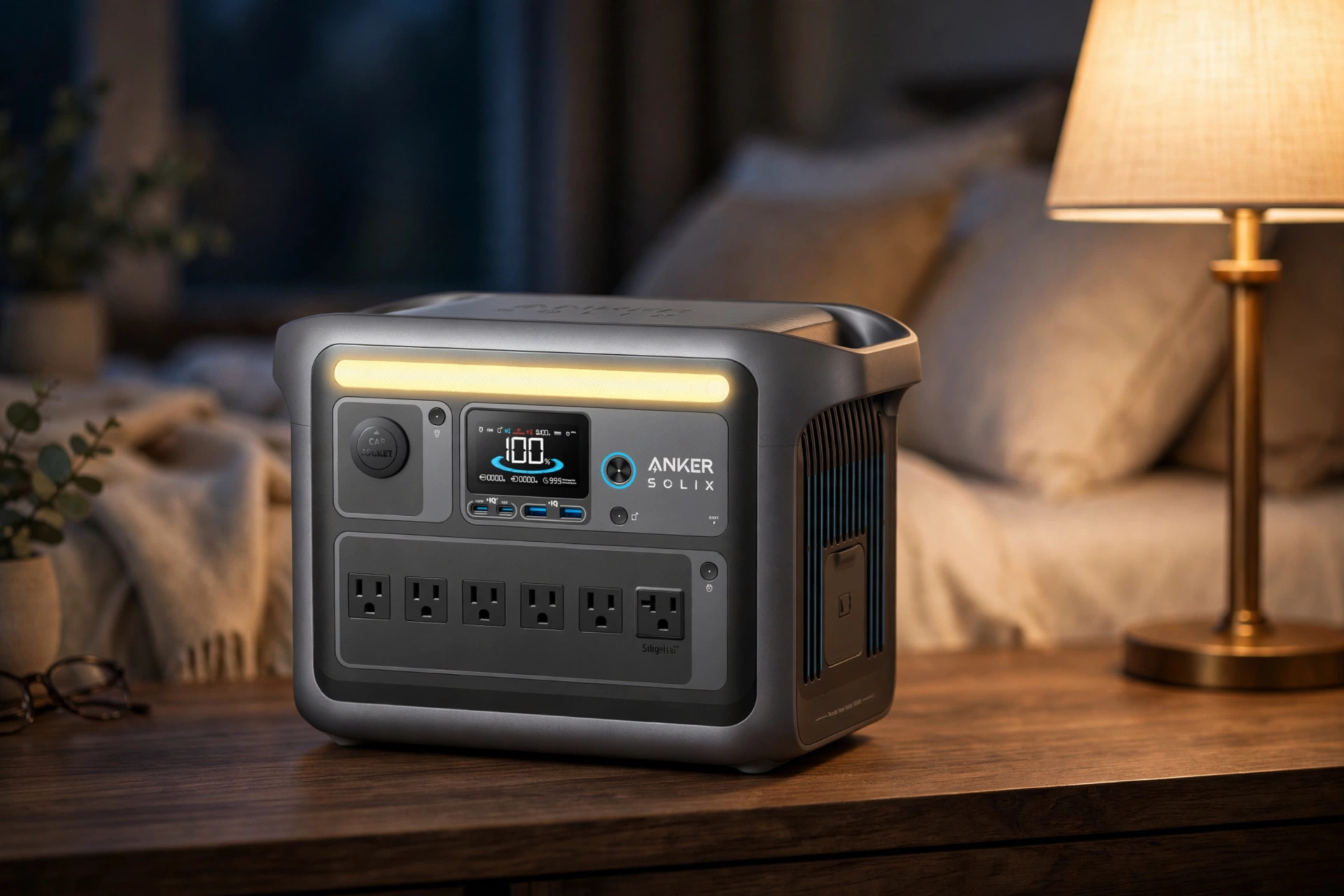
1,056Wh in one of the smaller footprints of this class, with fast charging and a 10ms-class UPS mode on recent revisions (verify the exact variant’s spec sheet). A good fit when the station doubles as a travel companion or lives in a small bedroom. Output is lower than the Delta 2 class, but CPAP loads never come close to testing it. Around $430 at time of writing. Check price
Strengths: compact size, fast UPS switchover for outage backup, competitive price. Trade-offs: lower continuous output if you ever want to run bigger appliances, smaller solar input.
BLUETTI Elite 100 V2: best for solar refills
1,024Wh, 1,800W output, and strong solar input specs for its size, making it the pick if multi-night off-grid CPAP use with daytime solar recharging is the plan. A 400W solar input can meaningfully refill this station during a day at camp. Around $450 at time of writing. Check price
Strengths: best solar input in this group, high output, LFP chemistry. Trade-offs: app is functional but less polished than EcoFlow’s, brand support network is smaller.
Traveling with a CPAP and a power station
For car camping and road trips, a 1,000Wh-class station plus a DC adapter is the sweet spot: two to three dry nights per charge, refill from the car’s 12V socket while driving (slow, but it adds up) or from a portable solar panel at camp.
For air travel, the math changes completely. Airlines cap lithium batteries at 100Wh in carry-on, or 160Wh with airline approval. No full-size power station flies. For flying with a CPAP, look at dedicated CPAP battery packs (typically 90-160Wh, one dry night) rather than portable power stations, and confirm your airline’s policy before booking.
One more travel tip: hotel and campground outlets are sometimes on switched circuits or shared with high-draw appliances. A station you charged at home removes that variable entirely.
A note on medical advice
This guide covers power sizing only. It is not medical advice, and nothing here replaces guidance from your doctor or sleep specialist about your therapy. If you depend on a CPAP, talk to your equipment provider about backup power for your specific machine, and test your full setup (station, adapter, machine, mask) at home before you ever need it in an emergency.
GadgetPreview is reader-supported. When you buy through links on our site, we may earn an affiliate commission.
Frequently asked questions
How long will a 1,000Wh power station run my CPAP?
About three 8-hour nights without the heated humidifier (roughly 282Wh per night after inverter loss), or about one night with the humidifier on (roughly 753Wh per night). A 12V DC adapter stretches this 20 to 30 percent further by skipping the inverter.
Can I use my heated humidifier with a portable power station?
Yes, but it roughly triples power consumption, from 15-40W to 60-100W. For outage backup this often means jumping from a 500Wh station to a 1,000Wh station. If you can sleep without the humidifier during an outage, you can buy much smaller.
Do I need a pure sine wave inverter for my CPAP?
Yes. CPAP machines contain motors designed for clean household-style power. Every reputable portable power station uses pure sine wave inverters now, but verify it on the spec sheet before buying a budget brand.
Can I take a portable power station on a plane for my CPAP?
No. Airlines cap lithium batteries at 100Wh in carry-on (160Wh with airline approval), and no full-size power station qualifies. For air travel with a CPAP, use a dedicated CPAP battery pack (typically 90-160Wh) and confirm your airline’s policy before booking.
Read next
- What Size Portable Power Station Do I Need? — the sizing formula behind the runtime math above.
- Portable Power Station for Camping — sizing, solar recharging, and etiquette for off-grid trips.
- Portable Power Station Not Charging? 7 Fixes to Try — what to check when a station will not take a charge.
Leave a Reply