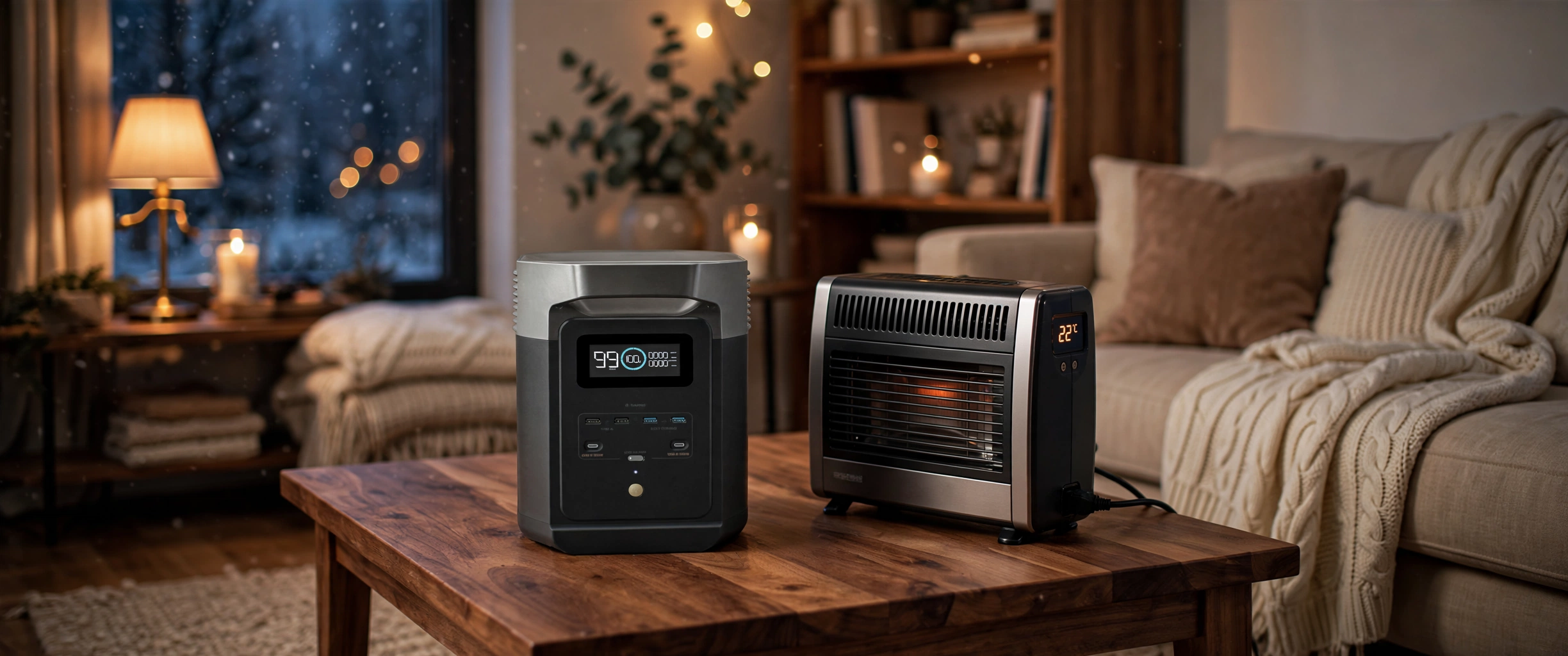
It is one of the most common winter questions: the power goes out, it is freezing, and you wonder if your portable power station can run a space heater. The honest answer is that it technically can — but the math is brutal, and for most people it is a bad idea. This article walks through the real numbers, explains why heaters are uniquely punishing for batteries, and covers what to use instead. All figures are based on manufacturer specifications and standard electrical math; no lab testing involved.
- The short answer
- The math: why heaters eat batteries
- Runtime table: heater vs station size
- What it actually takes to heat with a battery
- The one viable option: EcoFlow Delta 2 Max
- Better alternatives for staying warm
- Safety notes
- Frequently asked questions
The short answer
A typical plug-in space heater draws 750W on low and 1,500W on high. A 1,000Wh portable power station — the most popular size — runs a 1,500W heater for about 35 minutes. That is the whole story: space heaters convert electricity into heat at enormous wattage, and batteries store a finite amount of energy. You would drain a $500 power station before the room gets warm.
There is exactly one scenario where it makes sense: a brief, targeted burst of heat — warming up a small bathroom before a shower during an outage, for example — using a large 2kWh-class station. For sustained heating, batteries are the wrong tool.
The math: why heaters eat batteries
Runtime follows one formula: (station watt-hours × 0.85 for inverter loss) ÷ heater watts = hours of heat.
Most space heaters are resistive heating elements, which means they draw their full rated wattage continuously — there is no efficient “eco mode” trick the way there is with LED lights or laptop chargers. A 1,500W heater pulls 1,500W whether the room is freezing or nearly warm (until the thermostat cycles it off, which only helps if the room is already insulated and small).
Compare that to typical household loads: a phone charger draws 15W, a laptop 60W, an LED light string 10W, a CPAP machine 30W. A space heater on high draws 50 times what a CPAP machine draws. This is why a station that runs a CPAP for three nights dies in half an hour on a heater. For the full sizing method, see our sizing guide.
Runtime table: heater vs station size
Approximate runtimes for a 1,500W heater on high and a 750W heater on low, using the 0.85 inverter-efficiency factor:
| Station size | 1,500W heater (high) | 750W heater (low) |
|---|---|---|
| 256Wh (entry level) | ~9 minutes | ~17 minutes |
| 500Wh | ~17 minutes | ~34 minutes |
| 1,024Wh (most popular) | ~35 minutes | ~70 minutes |
| 2,048Wh (Delta 2 Max class) | ~70 minutes | ~2.3 hours |
Read that table twice. Even a large 2kWh station — a $1,000+ unit weighing 50 lbs — gives barely over an hour on high. Heating a room through an 8-hour winter night would require roughly 8–12kWh of battery, which means multiple large stations or a whole-home battery system costing many thousands of dollars.
What it actually takes to heat with a battery
Two things have to be true for battery heating to work at all:
1. The station’s output must exceed the heater’s draw. A 1,500W heater needs a station rated for at least 1,500W continuous — and ideally 1,800W+ for headroom, since heaters can spike at startup. Many popular 1kWh stations (1,500W output class) are right at the edge; check the spec sheet, not the marketing.
2. You must accept very short runtimes. Even when the output rating is sufficient, the energy math above still applies. Battery heating is a minutes-long proposition, not a hours-long one, unless you own several kilowatt-hours of storage.
There is one partial exception: thermostat cycling. In a small, well-insulated room, a heater cycles on and off once the target temperature is reached, and average draw can fall to half the rated wattage or less. That stretches a 2kWh station to 2–4 hours of maintaining warmth in a single closed bedroom — useful, but still not a full night.
The one viable option: EcoFlow Delta 2 Max
Among the products we cover, only one station is genuinely viable for brief heater use: the EcoFlow Delta 2 Max. Check price
Why it qualifies: 2,048Wh of LiFePO4 capacity, 2,400W continuous output (3,400W with X-Boost), and fast recharging (about 81 minutes from empty with dual input). It runs a 1,500W heater for roughly 70 minutes — enough to take the edge off a cold room or warm a bathroom — and it has the output headroom to do it without straining. Expandable to 6,144Wh with extra batteries for those who need longer.
Strengths for this use: highest output in its price class, large enough capacity for meaningful (if short) heating sessions, expandable. Limitations: 50 lbs — not something you carry room to room casually; and even this unit cannot heat through a full night alone.
Based on manufacturer specifications; we have not run heater discharge tests in our lab yet.
Better alternatives for staying warm
Batteries are bad at making heat, but excellent at running low-wattage warming devices. These alternatives sip power instead of gulping it:
- Electric heated blanket (50–100W): the single best battery-powered warming strategy. A 1,000Wh station runs a 75W blanket for ~11 hours — an entire night. Warm the person, not the room.
- Heated vest or jacket (20–40W): even more efficient; a small station runs one for a full day.
- Sleeping bag + station-powered fan ban: skip heating the air entirely. A good winter sleeping bag plus warm clothing beats any battery heater for overnight outages.
- 12V heated mattress pad (60–80W): runs off the station’s DC outlet (no inverter loss), warming the bed directly for 10+ hours on 1kWh.
- Hot water bottles: zero electricity. Heat water on a camp stove before the outage, fill bottles, and put them in the bed. Old technology, unbeatable efficiency.
The principle: resistive heating of air is the most wasteful use of stored electricity. Heating the person — blanket, vest, mattress pad — uses one-tenth the power for better comfort.
Safety notes
- Never run a fuel-burning heater indoors. This article is about electric heaters and power stations, but winter outages tempt people toward propane or kerosene heaters inside. Carbon monoxide kills — fuel heaters need ventilation, full stop.
- Do not exceed the station’s rated output. A 1,500W heater on a 1,200W-rated station will trip the overload protection at best and damage the inverter at worst. Check the spec plate.
- Keep heaters away from bedding and curtains even when battery-powered — the fire risk is the heater’s, not the battery’s.
- Do not run a heater off a station that is also charging. Pass-through charging under a 1,500W load stresses the battery and the charging circuitry; let the station do one job at a time.
Frequently asked questions
Can a Jackery or BLUETTI run a space heater?
The 1kWh-class models (Jackery Explorer 1000 v2 at 1,500W output, BLUETTI Elite 100 V2 at 1,800W) can technically run a 1,500W heater — but only for ~35 minutes before the battery is empty. Possible is not the same as practical.
What about oil-filled radiator heaters?
Same math. Oil-filled radiators typically draw 700–1,500W — identical to fan-forced space heaters from the battery’s perspective. The thermal mass smooths the heat delivery but does not reduce the energy consumed.
Can solar panels keep up with a heater?
No. A 400W solar array in perfect sun produces 400W; the heater consumes 1,500W. You would need roughly 2,000W of panels — an enormous array — just to break even, and that only works during daylight.
What is the best power station for winter outages overall?
For heat specifically: none — use a heated blanket instead. For general winter outage backup (lights, phones, fridge, CPAP), a 1–2kWh LiFePO4 station like the ones in our brand comparison is the right tool.
Leave a Reply