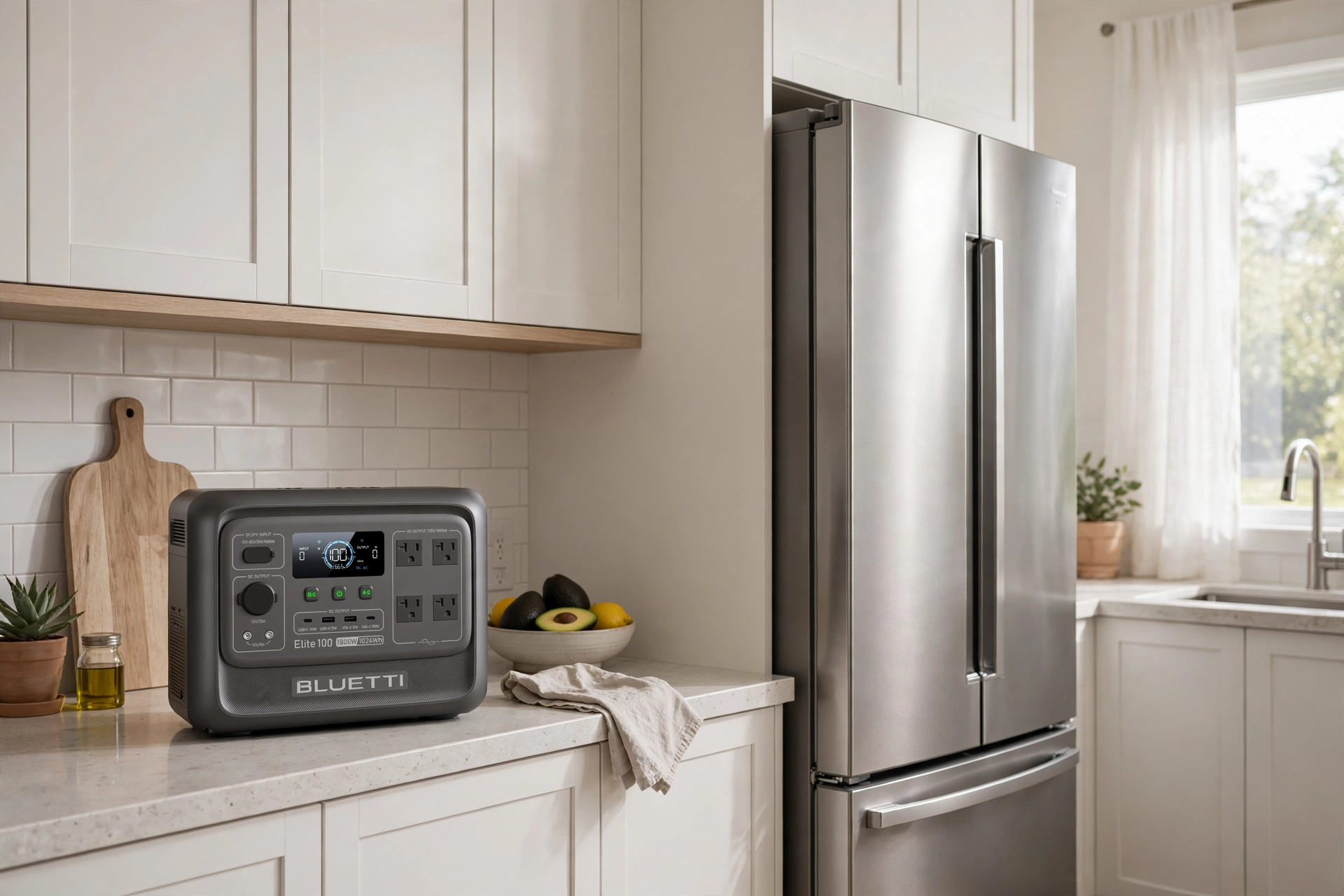
A full-size refrigerator is the appliance most people buy a portable power station for — and the one they size wrong most often. The math is simple once you know the two numbers that matter: how much power your fridge draws, and how much usable energy your station holds. This guide walks through both, with runtime tables for the most common station sizes.
- The runtime formula
- How much power a fridge actually uses
- Runtime table: 500Wh, 1000Wh, 2000Wh stations
- Don’t forget the startup surge
- Which stations can run a fridge
- How to stretch runtime
- Frequently asked questions
The runtime formula
Runtime in hours equals usable station capacity divided by the fridge’s average draw:
Hours = (Station Wh × 0.85) ÷ Fridge watts
The 0.85 factor accounts for inverter efficiency — converting the battery’s DC power to household AC wastes roughly 15 percent. Every reputable manufacturer rates capacity in watt-hours (Wh) at the battery, so this adjustment keeps the estimate honest.
A fridge does not draw its rated wattage continuously. The compressor cycles on and off: it runs hard to bring the temperature down, then idles while the insulation holds. Over 24 hours, a typical full-size fridge’s compressor runs about 8–12 hours total. The formula above already handles this if you use the fridge’s average draw rather than its peak — but for planning purposes, most people just use the running wattage and treat the result as a conservative estimate.
How much power a fridge actually uses
Fridge power draw varies more than most people expect. Here are realistic ranges:
- Mini fridge / dorm fridge: 50–100W running
- Full-size top-freezer: 100–200W running
- Full-size French-door / side-by-side: 150–250W running
- Chest freezer: 100–150W running
Check the label inside your fridge door or the manufacturer’s spec sheet for the rated wattage. If you only have the amperage, multiply amps by 120 (volts) to get watts. A fridge labeled 1.5A at 120V draws about 180W.
Older fridges draw more. A 15-year-old full-size unit can pull 200–300W where a modern Energy Star model pulls 100–150W. If your fridge predates 2010, budget for the higher end of the range.
Runtime table: 500Wh, 1000Wh, 2000Wh stations
Using the formula (Wh × 0.85 ÷ watts), here is how long common station sizes last against common fridge draws:
| Station size | 100W fridge | 150W fridge | 200W fridge |
|---|---|---|---|
| 500Wh | ~4.3 hours | ~2.8 hours | ~2.1 hours |
| 1000Wh | ~8.5 hours | ~5.7 hours | ~4.3 hours |
| 1500Wh | ~12.8 hours | ~8.5 hours | ~6.4 hours |
| 2000Wh | ~17 hours | ~11.3 hours | ~8.5 hours |
These are continuous-run estimates — the conservative case. In practice, a fridge’s compressor cycles, so real-world runtime often stretches 30–50 percent longer. A 1000Wh station on a 150W fridge might deliver 5.7 hours of compressor time spread across 8–9 hours of wall-clock time, because the compressor rests between cycles.
For overnight outage coverage (8–10 hours), a 1000Wh station handles most modern full-size fridges. For a full day, you want 2000Wh or a solar panel refilling a 1000Wh unit during daylight.
Don’t forget the startup surge
Here is where people get burned. A fridge compressor draws 3–5 times its running wattage for a few seconds when it kicks on. A 150W fridge can spike to 600–800W at startup. An older or larger unit can surge past 1,000W.
This matters because the station’s continuous output rating must clear the surge, not just the running watts. A 500Wh station with a 500W inverter cannot start a fridge that surges to 800W — the inverter trips, the compressor stalls, and your food stays warm.
Minimum output guidelines:
- Mini fridge: 300W+ continuous output
- Modern full-size fridge: 800–1,000W+ continuous output
- Older or large fridge: 1,200W+ continuous output
Most 1000Wh-class stations output 1,500–1,800W continuous, which clears typical fridge surges comfortably. Check your fridge’s locked-rotor amps (LRA) on the compressor label if you want the exact surge number — multiply LRA by 120V.
Which stations can run a fridge
These picks are based on manufacturer specifications, not lab testing yet. The two requirements are enough capacity for your needed runtime and enough output to clear the startup surge.
The EcoFlow Delta 2 Check price (1,024Wh, 1,800W output) is the sweet spot for most fridges: ~8.5 hours on a 100W fridge, and the 1,800W output handles startup surges from all but the oldest units. Fast wall recharging (~80 minutes) means a brief grid return refills it quickly.
For longer outages, the EcoFlow Delta 2 Max Check price (2,048Wh, 2,400W output) roughly doubles the runtime — ~17 hours on a 100W fridge, ~11 hours on a 150W unit. The 2,400W output clears virtually any residential fridge surge.
If you are sizing for more than just the fridge, start with our sizing guide — it covers the full watt-hour math for multi-device loads.
How to stretch runtime
- Pre-cool before the outage. Turn the fridge to its coldest setting while grid power is available. A colder thermal mass buys hours.
- Keep the door closed. Every opening dumps cold air. Plan what you need before opening.
- Move perishables to a cooler with ice and let the station handle only what must stay refrigerated.
- Add a solar panel. Even 200W of solar input meaningfully extends runtime during daylight — a 1000Wh station with 200W solar can run a 150W fridge nearly indefinitely in good sun.
- Unplug the ice maker and water dispenser. They draw standby power and cycle unexpectedly.
What about running a fridge and freezer together?
Many households have both — a kitchen fridge and a garage chest freezer. The math is additive: add both running wattages together, then check the total against the station’s continuous output rating.
A typical combo: 150W kitchen fridge + 120W chest freezer = 270W running, with combined startup surges potentially hitting 1,200–1,500W if both compressors kick on simultaneously (rare, but possible after a power restore). A 1000Wh station with 1,800W output handles this; a 500Wh unit with 500W output does not.
Runtime for the combo on a 1000Wh station: (1000 × 0.85) ÷ 270 ≈ 3.1 hours of compressor time, stretching to 5–6 wall-clock hours with cycling. For both appliances through an overnight outage, step up to 2000Wh.
One practical trick: the freezer holds temperature far longer than the fridge if unopened — frozen food is a thermal battery. In a pinch, power only the fridge and let the freezer coast. A full chest freezer keeps food safe for 48 hours unopened; a fridge manages about 4 hours. Prioritize accordingly.
Frequently asked questions
Can a 500Wh station run a full-size fridge?
Briefly, and only if its output clears the startup surge. Expect 2–4 hours of runtime. A 500Wh unit is better suited to mini fridges.
Will the fridge be damaged by a power station?
Not if the station uses a pure sine wave inverter — every reputable current model does. Modified sine wave inverters can stress compressor motors, but those are rare in this category now.
How do I know my fridge’s exact wattage?
Check the label inside the door or the spec sheet. Or use a $20–30 plug-in watt meter for a day to measure real consumption including cycling.
Can I run the fridge and freezer at once?
Add both wattages together and check the total against the station’s continuous output. Two full-size units usually need a 2000Wh-class station.
Read next
- Best Portable Power Station for Power Outage — station picks and planning for keeping food cold through an outage.
- Portable Power Station vs Generator — which backup source fits a long outage.
Leave a Reply