Camping with a CPAP machine used to mean either skipping therapy for the weekend or hauling a gas generator into the woods. A portable power station plus a solar panel solves it cleanly: the station runs your CPAP overnight, and the panel refills it during the day. Do it right and you can camp indefinitely with zero generator noise. This guide covers the power math, the solar sizing, and which stations fit — all based on manufacturer specifications, since our test lab is not running yet.
- The power math: CPAP + a night outdoors
- Solar sizing: refilling by day
- What to look for in a CPAP camping station
- Our picks (spec-based)
- Setup tips for the campsite
- What not to do
- Frequently asked questions
The power math: CPAP + a night outdoors
Everything starts with how much power your CPAP actually draws. The heated humidifier is the whole story:
- Without humidifier: most machines draw 15–40W. At a typical 30W over 8 hours, that is 240Wh per night — about 282Wh of station capacity after inverter losses.
- With heated humidifier and heated hose: draw climbs to 60–100W. At 80W over 8 hours, that is 640Wh per night, or about 753Wh of station capacity.
The humidifier roughly triples your power need. Outdoors, many campers find they can skip it for a few nights — cool night air is naturally less drying than heated bedroom air — and that single choice can shrink the required station from 1kWh to under 300Wh. For the complete CPAP power breakdown, see our CPAP guide.
Add your other camp loads on top: phones (15Wh each per full charge), camp lights (a 10W string for 5 hours = 50Wh), and maybe a small fan (20W × 8 hours = 160Wh). A realistic “CPAP + basics” night lands around 400–500Wh without a humidifier, or 900–1,000Wh with one.
Solar sizing: refilling by day
The solar panel’s job is to replace what the night consumed. The math is simple: panel watts × peak sun hours × 0.75 (real-world efficiency) = watt-hours recovered.
- 200W panel × 5 sun hours × 0.75 = 750Wh per day. Covers a humidifier-free CPAP night plus camp basics, with margin.
- 400W of panels × 5 sun hours × 0.75 = 1,500Wh per day. Covers a humidified CPAP night plus everything else.
Two things matter as much as panel size. First, the station’s max solar input caps what the panel can deliver — a 400W panel on a station with 110W max solar input wastes most of the panel. Second, shade kills output: a panel half-shaded by trees can drop to 20% of rated watts. Park the panel in full sun even if the tent sits in shade; most portable panels come with long cables for exactly this reason.
For general camping power planning beyond CPAP, our camping guide walks through sizing for fridges, cooking, and multi-day trips.
What to look for in a CPAP camping station
Enough capacity for your worst night. Size for the humidifier even if you plan to skip it — weather changes plans. A 1,000Wh-class station covers a humidified night plus camp basics with margin.
Strong solar input. This is the spec that separates good CPAP-camping stations from bad ones. Look for 400W+ of max solar input; 500W or more lets a single large panel refill the station in one good day.
12V DC output for the CPAP adapter. A manufacturer DC adapter plugs your CPAP straight into the station’s car-style outlet, skipping the inverter and stretching runtime 20–30%. Every station below has one.
Weight you will actually carry. A 1,000Wh station weighs 24–27 lbs. Fine for car camping; too heavy for backpacking. If you hike to your site, you are looking at a different (much smaller) class of gear.
Pure sine wave inverter. CPAP machines contain motors that expect clean power. Every reputable station uses pure sine wave inverters now, but verify it on the spec sheet.
Our picks (spec-based)
These picks are based on manufacturer specifications and published owner data, not lab testing yet.
EcoFlow Delta 2: the balanced pick
1,024Wh LiFePO4, 1,800W output, and 500W max solar input. A 400W panel refills it in about 3 hours of good sun — comfortably within a camping day. Handles a humidified CPAP night (~753Wh) plus phones and lights with room to spare. The fastest wall recharge in its class (about 80 minutes) is a bonus if you top up at a trailhead café or a friend’s house on the way. Around $400 on sale. Check price
Strengths: best all-round specs for the money, huge accessory ecosystem, frequent deep discounts. Trade-offs: 500W solar ceiling means a very large panel array is partially wasted; heavier than the Jackery below is not an issue since both are car-camping weights.
BLUETTI Elite 100 V2: the solar champion
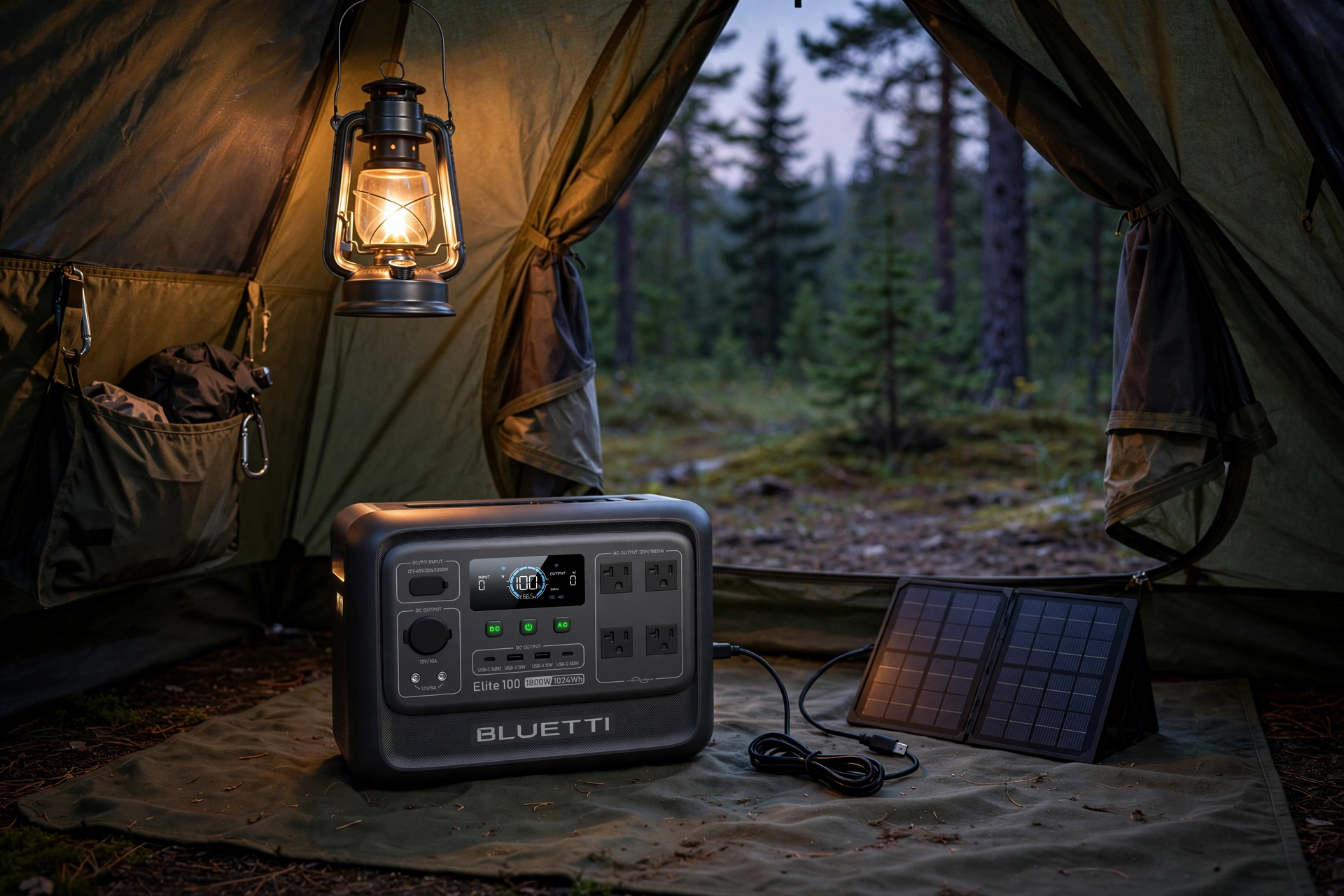
1,024Wh LiFePO4, 1,800W output (2,700W Powerlifting), and a class-leading 1,000W max solar input. This is the station to buy if solar is the whole point: it can absorb a full 400W panel array with headroom to spare, refilling from empty in about 1.5 hours of peak sun. For multi-day trips where every daylight hour counts, nothing else at this size keeps up. Check price
Strengths: double the solar input of the Delta 2, 45-minute fast wall charging, strong price-per-Wh on sale. Trade-offs: narrower accessory ecosystem than EcoFlow.
Jackery Explorer 1000 v2: the simple pick
1,070Wh LiFePO4, 1,500W output, 400W max solar input, and the most straightforward interface of the three — which matters when you are setting up camp at dusk. The 5-year warranty leads the group. Solar refills take a bit longer than the BLUETTI (400W ceiling), but a single 200W panel still replaces a humidifier-free night’s consumption in about 4 sun hours. Check price
Strengths: simplest to operate, longest warranty, most polished out-of-box experience. Trade-offs: lowest solar input of the three, usually the highest price.
Setup tips for the campsite
- Bring the DC adapter. The 12V CPAP adapter (roughly $30–90 depending on brand) skips the inverter and buys you 20–30% more runtime. It is the highest-value accessory in this entire setup.
- Panel placement beats panel size. A 200W panel in full sun outperforms a 400W panel in dappled shade. Reposition at midday if you can.
- Charge while the sun is up, not after dark. Obvious, but campers routinely forget: plug the panel in the moment you make camp, not at bedtime.
- Keep the station in the tent vestibule, not inside the tent. It needs ventilation while charging, and the fan noise — minimal on these units — stays outside your sleeping area.
- Test at home first. Run your exact CPAP + humidifier setup off the station for one full night in your bedroom before trusting it in the woods. Note the exact percentage consumed; that is your real number, not the brochure’s.
What not to do
- Do not run the humidifier off a sub-500Wh station. At ~753Wh per humidified night, a small station dies before morning. Either skip the humidifier or bring a 1kWh-class unit.
- Do not count on a full recharge from a cloudy day. Heavy overcast can cut solar output to 10–25% of rated watts. Bring enough capacity for two nights as a buffer, or plan a wall-charge stop.
- Do not leave the station in a hot car. Lithium batteries degrade faster with heat, and a sealed car in summer sun can exceed safe storage temperatures. Shade it or bring it into the tent.
Frequently asked questions
Can I really camp multiple nights with a CPAP on solar?
Yes, if the daily solar harvest covers the nightly consumption. A 1,000Wh station plus a 200–400W panel sustains a humidifier-free CPAP night indefinitely in decent weather. With a humidifier, you need the larger panel or a bigger station.
What size solar panel do I need for CPAP camping?
Minimum 200W for a humidifier-free setup; 400W if you run the humidifier. Match the panel to the station’s max solar input — check the spec table before buying.
Can I fly with a portable power station for CPAP travel?
No, not these sizes. Airlines cap lithium batteries at 100Wh carry-on (160Wh with approval). Full-size stations travel by car only. For air travel, look at FAA-compliant CPAP battery packs under 100Wh.
Is it safe to run a CPAP off a power station?
Yes, with a pure sine wave inverter — which all three picks have. Use the manufacturer’s DC adapter when possible, and test the full-night runtime at home first.
Leave a Reply