
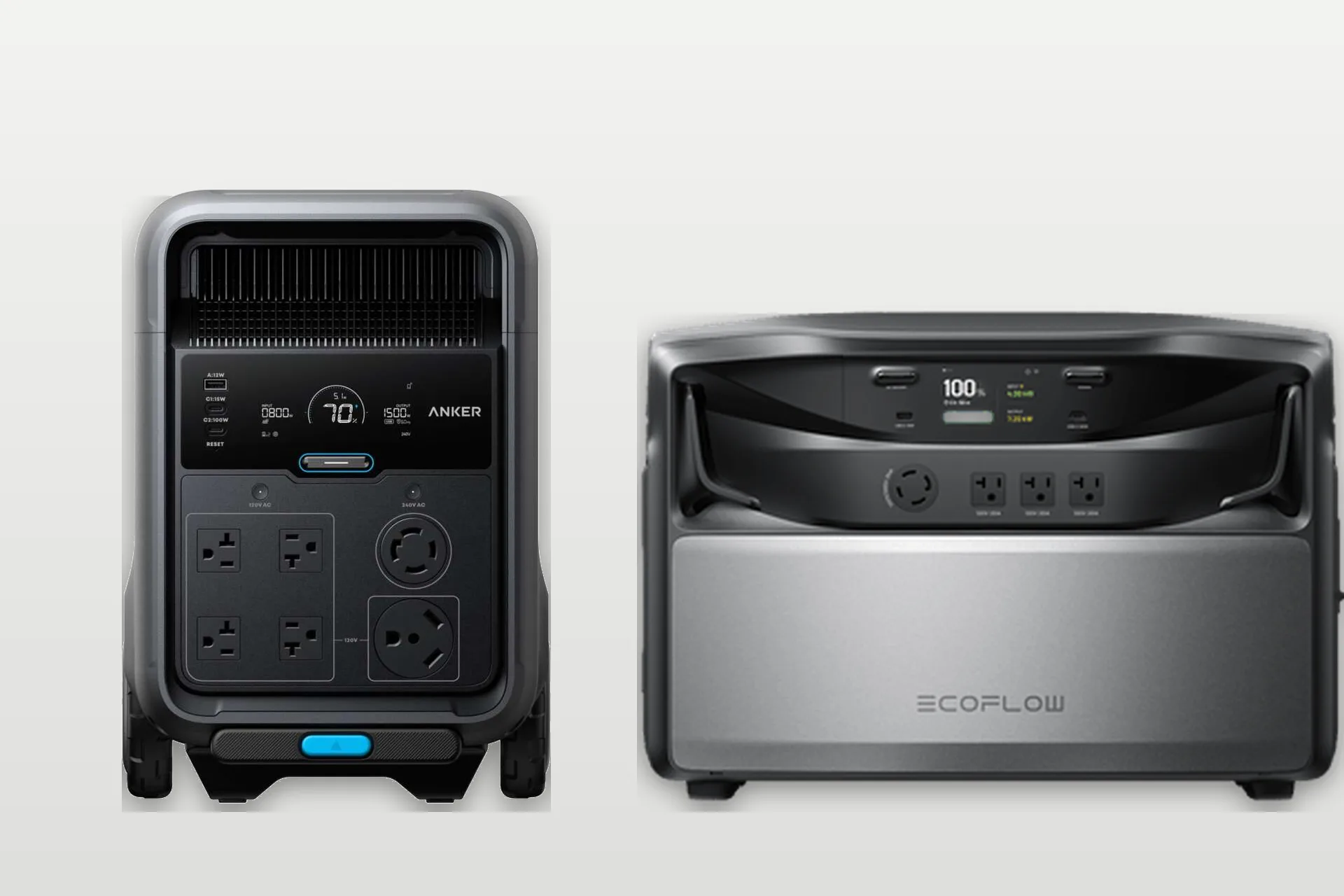
Within four days in October 2026, Anker and EcoFlow both launched 5kWh home backup systems — and they could not be more different in approach. The Anker SOLIX S5000 is a rolling portable power station: 5,024Wh, 4,500W of output, wheels, a handle, no installer required. The EcoFlow TITAN 5000 series is a home battery system that happens to start at the same 5kWh: up to 7,200W of output, a smart breaker panel, and professional installation. Same capacity class, two philosophies. This comparison is based entirely on manufacturer specifications and launch pricing; neither unit has been lab-tested by us, and both are too new for long-term reliability data.
- The quick answer
- Head-to-head spec table
- The TITAN family: Plus, standard, and Classic
- What 5,000Wh actually runs during an outage
- Where the S5000 wins: the portable case
- Where the TITAN wins: the installed case
- The real costs, including installation
- What we do not know yet
- Verdict: which one should you buy
- Frequently asked questions
The quick answer
Buy the Anker SOLIX S5000 if you want 5kWh of backup without touching your breaker panel: it rolls into place, plugs into any outlet, recharges in about 99 minutes from a 240V source, and launches at $2,499.99 — the lowest confirmed price per watt-hour in this class. Buy the EcoFlow TITAN 5000 if you are a homeowner who wants automatic, panel-integrated whole-home backup: 7,200W of split-phase output, 10 backed-up circuits through the Smart Home Panel 10, and solar input up to 8,000W on the Plus model — at a higher all-in cost once the panel and installation are added. If you only need a fridge, lights, Wi-Fi, and a CPAP machine through the night, both are more than you need; a 2kWh-class station from our brand comparison does that job for a third of the price.
Head-to-head spec table
Manufacturer specifications. The TITAN column is the standard TITAN 5000; the Plus and Classic variants are broken out in the next section.
| Spec | Anker SOLIX S5000 | EcoFlow TITAN 5000 |
|---|---|---|
| Capacity | 5,024Wh | 5,017.6Wh |
| Battery chemistry | LiFePO4 (314Ah cells) | LiFePO4 (40160 cells) |
| Expandable to | 30kWh | 30kWh |
| Rated output | 4,500W | 7,200W |
| Peak / surge output | 8,000W | Not yet published |
| Voltage | 120V / 240V | 120V / 240V split-phase |
| AC outlets | 4× NEMA 5-20, 1× TT-30, 1× L14-30 | 3× NEMA 5-20, 1× L14-30R, USB-C + USB-A |
| Max solar input | 3,000W (two inputs) | 4,000W (one MPPT) |
| AC recharge | 0–100% in ~99 min at 240V (1,800W max at 120V) | Up to 7,200W AC input |
| Switchover | 10ms UPS | Under 20ms with Smart Home Panel 10 |
| Cycle life (rated) | 6,000 cycles to 80% (10,000 to 60%) | Not yet published |
| Weight | 97 lbs, wheels + telescopic handle | 119 lbs, fixed placement |
| Weather rating | Indoor use | IP20 (indoor) |
| Warranty | 5 years | 5 years |
| US price | $2,499.99 launch (Oct 27) / $3,599.99 MSRP | From $3,199 standalone |
The TITAN family: Plus, standard, and Classic
EcoFlow sells three versions. All share the same 5,017.6Wh battery, 30kWh expansion ceiling, and Smart Home Panel 10 support:
| Model | Output | Solar input | Weight | Standalone price |
|---|---|---|---|---|
| TITAN 5000 Plus | 7,200W (up to 10kW with solar PV Boost) | 8,000W (2 MPPT) | 121.3 lbs | From $3,699 |
| TITAN 5000 | 7,200W | 4,000W (1 MPPT) | 119 lbs | From $3,199 |
| TITAN 5000 Classic | 4,000W, 120V only | 3,200W (1 MPPT) | 110.2 lbs | From $2,499 |
The Plus is the flagship: EcoFlow rates it to start a compatible 3-ton central air conditioner without a soft starter, and it is the only model with a 50-amp L14-50 outlet. The Classic is the budget pick, but its 120V-only output means no central AC, no electric dryer, and most well pumps stay dark — it is an essentials-only machine, closer in spirit to the S5000 than to its siblings.
What 5,000Wh actually runs during an outage
First, a clarification that matters for this whole category: 5,000Wh is capacity, not output. Watt-hours say how long power lasts; watts say what you can run at once. Searches for a “5000 watt power station” usually mean this 5kWh capacity class — the two numbers are not interchangeable, and confusing them is how people end up under- or over-buying. Our size calculator shows the math for your own appliance list.
Using the same convention as our calculator — about 85% of rated capacity is usable after inverter and system losses — both base units give you roughly 4,270Wh of working energy:
| Load scenario | Average draw | Estimated runtime on 5kWh |
|---|---|---|
| Full-size refrigerator alone (compressor cycling) | ~50W average | ~85 hours |
| Essentials: fridge + Wi-Fi router + LED lights + CPAP | ~200W | ~21 hours |
| Essentials + window AC cycling | ~600W | ~7 hours |
| Space heater on high | 1,500W | ~2.8 hours |
These are our spec-based estimates, not measurements. They line up well with Anker’s own published figure of up to 86 hours for a refrigerator alone (a 700L fridge at 77°F ambient, per Anker’s test notes). Two things work in the S5000’s favor in this math: its idle draw is just 8.8W in 120V mode — about 0.21kWh per day burned just staying awake — and its rated efficiency is up to 96% at a 1,000W load. EcoFlow has not published an idle-draw figure for the TITAN series yet; on an installed system that runs 24/7, that number matters and we will update this article when it appears. For the smaller end of the scale, our sizing guide covers what 1–2kWh stations handle.
Where the S5000 wins: the portable case
No installation, ever. The S5000 arrives, rolls off the truck on its own wheels, and plugs into a wall outlet. Renters, condo owners, and anyone who cannot modify a breaker panel get real 5kWh backup without an electrician, a permit, or a landlord conversation.
Recharge speed. From a 240V, 4,500W source, Anker rates a full recharge at about 99 minutes (64 minutes to 80%). During a multi-day outage with intermittent grid power or a generator window, that is the difference between refilling the battery and rationing it. Solar input is a healthy 3,000W across two ports.
Efficiency credentials. The S5000 carries a TÜV SÜD A+ Runtime rating — the first 5kWh station to earn it, per Anker — covering usable output energy, conversion efficiency, energy retention, and energy density. It is also UL 9540 certified and tested to UL 9540A. Marketing claims aside (“longest-lasting in class” is based on Anker’s own testing against selected competitors), the underlying numbers — 8.8W idle, 96% light-load efficiency, 6,000 cycles to 80% — are strong for the class.
Price per watt-hour. At the $2,499.99 launch price, the S5000 costs $0.50 per watt-hour — territory previously owned by budget brands, not by a Big Four nameplate. Even at the $3,599.99 MSRP it is $0.72/Wh.
The trade-offs: 4,500W of continuous output is the ceiling, so simultaneous heavy loads need managing; 97 lbs is “portable” only in the sense that it has wheels; and it is a plug-in device — when the power dies, you are running extension cords unless you wire a manual transfer switch yourself.
Where the TITAN wins: the installed case
Output headroom. 7,200W of split-phase output is 60% more than the S5000 delivers, and the Plus model pushes to 10kW when solar is feeding it. That is the output class where central air conditioners, well pumps, electric dryers, and ranges become realistic — loads the S5000 mostly cannot start.
Panel integration. Through the Smart Home Panel 10, the TITAN backs up 10 chosen circuits automatically, switching in under 20ms, with per-circuit control in the EcoFlow app and storm alerts that top the battery up ahead of severe weather. No cords, no manual changeover at 2 a.m. This is the actual product: the battery is half the system.
Solar and daily savings. The Plus accepts 8,000W of solar input — more than double the S5000 — and EcoFlow’s OASIS 3.0 management can charge off-peak and discharge at peak rates. For a homeowner with rooftop solar or time-of-use pricing, the TITAN is partly an everyday bill-reduction device, not just outage insurance.
The trade-offs: it is a fixed, indoor (IP20) installation at 110–121 lbs per unit; expansion means more 83-lb battery boxes in the same room; and the whole-home experience is not the standalone price — see the costs section next. EcoFlow also has not yet published surge ratings or cycle-life figures for the series, a genuine gap for a system sold on appliance-starting ability.
The real costs, including installation
The S5000’s cost is the sticker: $2,499.99 at launch (October 27, through Anker’s site and Amazon), $3,599.99 MSRP after the launch window. Anker is adding a bonus package valued at $699 — a two-year warranty extension, a charging station, and a generator charging cable — for buyers who sign up by October 26 and purchase by November 9. Expansion battery pricing has not been published yet.
The TITAN’s cost depends on how much of the system you buy. Standalone units list from $2,499 (Classic), $3,199 (5000), and $3,699 (Plus) on EcoFlow’s US store. EcoFlow quotes bundles with the Smart Home Panel 10 and installation in the $5,000 range for the Classic and $7,000 range for the 5000/Plus, with installation labor around $1,200. Early-bird reservations through November 2 include 5% off eligible units and two free 220W solar panels with a $50 coupon. Expansion battery pricing is likewise unpublished as of this writing.
One more name belongs in this conversation: the Jackery Explorer 5000 Plus (5,040Wh, 7,200W, expandable to 60kWh) is the incumbent in this class. It out-outputs the S5000 and needs no installation, but it is heavier still at about 134 lbs and generally priced above the S5000’s launch figure. If your priority is maximum plug-in output without a panel, it is the third option to price-check.
What we do not know yet
Both systems are weeks old. Honest gaps in the record:
- TITAN surge ratings and cycle life — not published by EcoFlow as of October 19. For a system marketed on starting a 3-ton AC, the surge number matters; we will add it when EcoFlow publishes it.
- Expansion battery pricing — both brands quote a 30kWh ceiling without US pricing for the extra batteries. The 30kWh total cost is currently unknowable.
- TITAN idle consumption — unpublished; relevant for an always-on installed system.
- Real-world reliability — neither unit has a field record. Both carry 5-year warranties, which is the main protection available today.
We will update this article as EcoFlow publishes the missing figures and as US street pricing settles after the launch windows.
Verdict: which one should you buy
Choose the Anker SOLIX S5000 if you rent, cannot modify your panel, want backup you can also roll to a garage, RV, or another house, or simply want the most watt-hours per dollar from a major brand today. It is the right default for outage essentials plus a 240V appliance or two. It goes on sale October 27 — see the S5000 at Anker SOLIX for launch terms.
Choose the EcoFlow TITAN 5000 (or Plus) if you own your home, want automatic whole-home backup through your breaker panel, need 7,200W-class output for central AC or a well pump, or have (or plan) a large solar array. Budget for the panel and installation, not just the battery — see the TITAN series at EcoFlow US for configuration pricing. Choose the Classic only if 120V essentials are genuinely all you need; its price advantage disappears if a 240V load ever joins the list.
Choose neither if your outage plan is a fridge, lights, Wi-Fi, phones, and a CPAP machine overnight. That is a 1–2kWh job — our power outage guide covers the right-sized picks, and you will keep $1,500 or more in your pocket.
One last reminder: this comparison is built from manufacturer specifications and launch materials. We have not run either system through discharge, cycle, or appliance-start testing, and manufacturer runtime figures are produced under each brand’s own test conditions.
Frequently asked questions
Is a 5kWh power station enough for a house?
For essentials, yes: a refrigerator, lights, Wi-Fi, phones, and a CPAP machine use roughly 4–5kWh over a full day if managed carefully, and both systems here expand to 30kWh for longer outages. For whole-house normalcy — central AC, electric cooking, laundry, and water heating at the same time — 5kWh is a starting point, not a full answer, and output (watts) becomes the limit before capacity does.
Can the Anker SOLIX S5000 run a central air conditioner?
Realistically, no. Its 4,500W output and 8,000W peak are short of what most central AC compressors need to start, and Anker’s own runtime claims cover a window AC (up to 25 hours) rather than a central system. EcoFlow rates the TITAN 5000 Plus to start a compatible 3-ton central AC — that is precisely the use case the TITAN’s 7,200W output exists for.
Which is better for a refrigerator during a long outage?
On paper, the S5000: its low 8.8W idle draw and high light-load efficiency stretch a fridge-only load to roughly 85 hours by our math, matching Anker’s published figure. The TITAN should land in the same range on capacity alone, but EcoFlow has not published an idle-draw figure to complete the comparison.
What is the difference between 5,000W and 5,000Wh?
Watts measure instant output — what the system can run at once. Watt-hours measure stored energy — how long it can run it. These are 5,000Wh-class batteries with outputs of 4,500W (S5000) and 4,000–7,200W (TITAN series). A “5000 watt” search usually lands here because the two numbers sit side by side in this class, but they describe different things.
Do either of these replace a gas generator?
For essentials and short-to-moderate outages, yes — silently and without fuel storage or carbon monoxide risk. For multi-day outages with heavy loads, a generator’s ability to refuel indefinitely still wins unless you pair these batteries with substantial solar. The honest answer depends on your outage length and load list; our sizing calculator can put numbers on both.
Leave a Reply