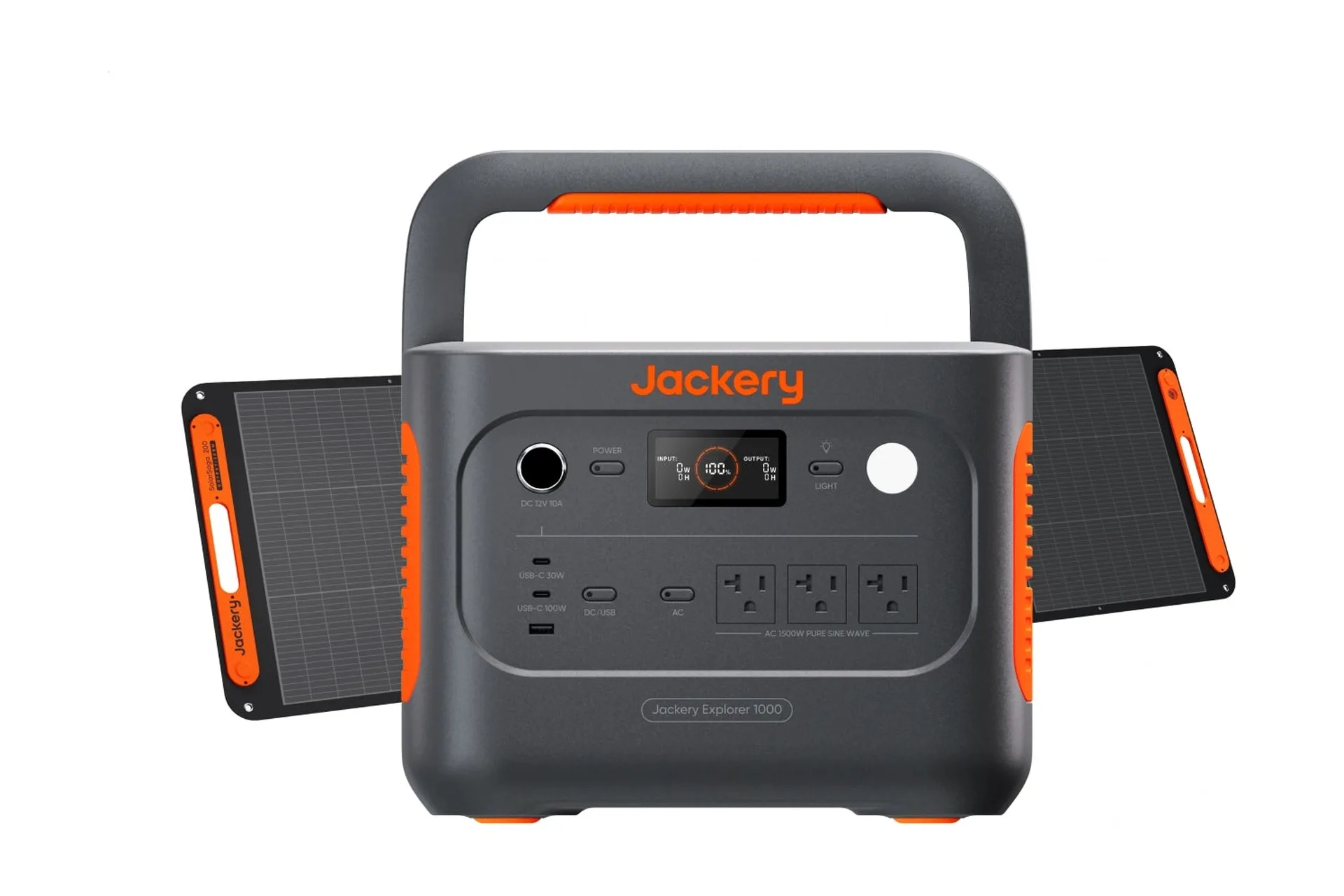
A solar generator is not a gas generator with a different fuel. It is a system: a portable power station that stores electricity in a battery, paired with solar panels that refill it during the day. The station decides what you can run and for how long. The panels decide whether you can keep running tomorrow. That is why this guide leads with solar input and charging, not capacity alone. Get the panel side wrong and a large station is a one-day battery. Get it right and it becomes a renewable supply for camping, outages, and off-grid work.
- What a solar generator actually is
- The solar math
- How to size a panel array to a station
- Our picks (spec-based)
- Solar generators for home backup
- Mistakes to avoid
- Frequently asked questions
GadgetPreview is reader-supported. When you buy through links on our site, we may earn an affiliate commission.
What a solar generator actually is
A complete solar generator has three parts. Panels convert sunlight into DC electricity. A charge controller inside the station regulates it to charge the battery safely. The station stores the energy — in a LiFePO4 battery in every pick below — and delivers it through AC outlets, USB ports, and 12V outputs via an inverter.
Two specifications control the system. Capacity, in watt-hours (Wh), is the size of the tank: how long loads run before the battery empties. Max solar input, in watts (W), is the size of the filler neck: it caps how fast sunlight can refill the tank, no matter how many panels you connect. A 2,000Wh station with 400W of input needs many hours of strong sun to recover. A 1,000Wh station with 1,000W of input recovers far faster.
For multi-day use the input figure matters more than listings suggest. If daily consumption exceeds daily harvest, the battery drains a little more each day until empty. If harvest exceeds consumption, the system is sustainable in fair weather. For stations sold with panels included, see a portable power station with solar panel, and for whole-home use, our solar generator for home overview.
The solar math
The sizing rule used across this site is: panel watts × peak sun hours × 0.75 = watt-hours recovered per day. Peak sun hours are the equivalent hours of full-strength sun at your location, commonly 4 to 6 in much of the United States in summer, fewer in winter. The 0.75 factor covers losses from panel angle, heat, cables, and conversion.
- 200W panel × 5 sun hours × 0.75 = 750Wh per day. Covers phones, lights, and a CPAP without a humidifier.
- 400W panel × 5 sun hours × 0.75 = 1,500Wh per day. Refills a 1,024Wh station in one good day, with energy left for daytime loads.
- 1,000W array × 5 sun hours × 0.75 = 3,750Wh per day — only if the station accepts 1,000W of input. On a 500W-capped station, that array delivers at most half that rate.
Work backwards from consumption: add up your daily load, then divide by sun hours and by 0.75. A 1,200Wh load with 5 sun hours needs 1,200 ÷ 5 ÷ 0.75 = 320W of panels minimum, so a 400W panel is the sensible choice. Our power station size calculator handles capacity, and what size portable power station do I need covers load audits.
How to size a panel array to a station
Treat max solar input as a hard ceiling. Panels beyond it are clipped: the station draws only what it can accept, and the surplus produces nothing. Modest over-paneling of roughly 10 to 20 percent — only within the manual’s voltage and current limits — can reach the cap earlier on hazy days. Large oversizing wastes money.
Next, match the array to the battery: aim for enough wattage to refill the station in one day of sun. For a 1,000Wh-class station in 5 sun hours, that is roughly 270W by the formula above, so manufacturer panels in the 200W to 400W class fit naturally: the EcoFlow 400W portable panel, the BLUETTI PV350 at 350W, the Jackery SolarSaga 200 at 200W, and the Anker Solix PS400 at 400W. Stations in the 2,000Wh class need 400W to 1,000W for a one-day recovery. Confirm connector type and input voltage before mixing brands.
Our picks (spec-based)
These picks are based on manufacturer specifications, since our test lab is not running yet. Rankings weigh max solar input first, then capacity, output, and weight.
Best overall: EcoFlow Delta 2 with a 400W panel
The Delta 2 pairs 1,024Wh of LiFePO4 capacity and 1,800W AC output with 500W of max solar input, so one EcoFlow 400W portable panel runs near its ceiling and can refill the station in one good day. At 27 lbs it remains car-portable, and the roughly 80-minute full AC recharge covers cloudy stretches. Around $400 on sale at time of writing, station only. Check price
Strengths: strong solar input, fast recharge. Trade-offs: 500W ceiling; capacity not expandable.
Best solar charging: BLUETTI Elite 100 V2
The Elite 100 V2 is built around one figure: 1,000W of max solar input, double the Delta 2 and the highest in the 1kWh class here. It can absorb a PV350 plus additional panels without clipping, refilling its 1,024Wh LiFePO4 battery in roughly an hour and a half of peak sun by rated figures. Output is 1,800W, rising to 2,700W in Powerlifting mode; weight is 25.3 lbs. Around $430 at time of writing. Check price
Strengths: class-leading solar input. Trade-offs: full 1,000W input requires more panels.
Best for home backup: BLUETTI Apex 200
The Apex 200 is the largest system here: 2,560Wh of LiFePO4 capacity, 3,200W output, and 3,000W of max solar input per BLUETTI launch materials — a ceiling high enough that panel size, not the station, becomes the limit. It expands with B300K-series batteries. At 59.3 lbs it is a stay-in-place backup unit. Priced at a $1,099 launch price against a $1,399 regular price at time of writing. Check price
Strengths: largest capacity, output, and solar ceiling here. Trade-offs: heavy; expansion batteries add cost.
Fastest recharge: Anker Solix C1000 Gen 2
The C1000 Gen 2 offers 1,024Wh of LiFePO4 capacity, 2,000W output with 3,000W peak, and 600W of max solar input — above the Delta 2. It takes the Anker Solix PS400 400W panel with headroom, and recharges 0–100% on AC in about 49 minutes by manufacturer rating, the fastest in this guide. Weight is about 24.9 lbs. The trade-off against the first-generation C1000 is expansion: the Gen 2 is a fixed-capacity design. Around $530–550 at time of writing. Check price
Strengths: 600W input, 2,000W output, fastest recharge. Trade-offs: no expansion battery; trails the Elite 100 V2 for harvest speed.
Best plug-and-play bundle: Jackery Explorer 1000 v2 with SolarSaga 200
Jackery sells the Explorer 1000 v2 and SolarSaga 200 as a matched bundle, removing connector and sizing guesswork. The station provides 1,070Wh of LiFePO4 capacity and 1,500W output, accepts up to 400W of solar input — so a second SolarSaga 200 can be added later — and at 23.8 lbs is the lightest 1kWh-class station here. One 200W panel returns about 750Wh per day in 5 sun hours; two approach a full refill. Around $450–500 at time of writing, station only. Check price
Strengths: lightest in class; second-panel path. Trade-offs: lowest output and input among the 1kWh picks.
Best for long outages: EcoFlow Delta 2 Max
The Delta 2 Max targets endurance: 2,048Wh of LiFePO4 capacity, 2,400W output, and 1,000W of max solar input, expandable to 6,144Wh with extra batteries. That input matters over multiple days — 1,000W of panels in 5 sun hours yields about 3,750Wh per day, more than the base battery holds. At 50 lbs it is car-transportable, not a casual carry. Around $1,000–1,200 on sale at time of writing. Check price
Strengths: large expandable capacity, large input. Trade-offs: price and weight step up.
Best portable: EcoFlow River 2 Pro with a 220W panel
The River 2 Pro is the small-system pick: 768Wh of LiFePO4 capacity, 800W AC output, and 17 lbs. Its 220W max solar input matches a single 220W-class panel exactly — that panel returns about 825Wh per day in 5 sun hours, a full refill plus margin for phones and lights. It will not run large appliances, but for one-person camping and CPAP use it covers the load at half the weight of the 1kWh class; see our best solar generator for CPAP camping guide. Around $300 on sale at time of writing. Check price
Strengths: lightest pick; panel matched to input cap. Trade-offs: smallest capacity and output.
Solar generators for home backup
Home backup is where solar earns its cost. A typical modern fridge consumes roughly 1,000 to 1,500Wh per day once compressor cycling is counted. The Apex 200, at 2,560Wh, covers about two days of refrigeration on battery alone. Add 1,000W of panels — well under its 3,000W ceiling — and 5 sun hours return about 3,750Wh per day, more than the fridge consumes, so the outage can extend in fair weather.
The Delta 2 Max follows the same pattern at a smaller scale: 2,048Wh covers roughly a day and a half of refrigeration, its 1,000W input allows the same harvest, and expansion to 6,144Wh adds cloudy-day buffer. Neither replaces a whole-home generator for central air conditioning or electric heating. See our best portable power station for home backup roundup and our guides section.
Mistakes to avoid
- Oversizing panels past the input cap. A 400W panel on a station with 220W max input delivers at most 220W. The unused wattage buys nothing.
- Expecting rated watts in winter or shade. Ratings assume full sun and ideal conditions. Low winter sun and partial shade can cut output to a fraction of the nameplate figure. The 0.75 factor is a planning number, not a guarantee.
- Forgetting grid backup. Several overcast days in a row will defeat any reasonably sized array. Keep the AC charger ready; treat wall power or a vehicle as the backup to the backup.
- Sizing to capacity alone. A large battery with small solar input is a countdown timer. Size harvest to daily consumption first, then choose capacity to buffer nights and cloudy hours.
Frequently asked questions
What is the difference between a solar generator and a portable power station?
A portable power station is the battery-and-inverter box alone. A solar generator is that station paired with panels, used as one system. The station provides capacity and output; the panels provide ongoing energy. Without panels, it must be refilled from a wall outlet or vehicle.
How many solar panels do I need for a 1,000Wh station?
To refill 1,000Wh in one day with 5 peak sun hours, the formula gives 1,000 ÷ 5 ÷ 0.75, or about 270W of panels minimum. In practice a single 400W panel is common, provided the station’s max solar input accepts it. Stations capped at 200W to 220W need a matched smaller panel.
Can a solar generator run a refrigerator during an outage?
Yes, within capacity limits. A typical fridge uses about 1,000 to 1,500Wh per day, so a 2,048Wh to 2,560Wh station runs it for roughly one and a half to two and a half days on battery alone. Add about 400W of panels — roughly 1,500Wh in 5 sun hours — and runtime extends while sunny weather holds.
How long does it take to recharge a station from solar panels?
Divide usable capacity by the power panels actually deliver. A 1,024Wh station fed by a 400W panel producing about 300W refills in roughly three and a half hours of good sun. At 1,000W input with a matching array, the same battery can refill in little more than an hour of peak sun by rated figures.
Do solar generators work on cloudy days?
They work at reduced output. Heavy overcast can cut production to a small fraction of rated watts, and several cloudy days in a row will drain a station powering daily loads. Size the battery to buffer at least one poor day, and keep the AC charger available for essential loads.
Leave a Reply