A portable power station is the simplest way to keep a fridge cold, a CPAP running, phones charged, and lights on — at home during an outage, at a campsite, or in a work van — without fuel, fumes, or noise. The right pick is mostly a sizing decision: enough watt-hours for your loads, enough AC output for your largest appliance, and enough solar input to refill at the pace you need. The seven stations below cover every sensible role, from a 17 lb grab-and-go unit to a 2,560Wh top-end model.
- How the picks were chosen
- Comparison table
- The seven picks
- How to choose your size
- What specs actually matter
- Who should skip a portable station
- Frequently asked questions
GadgetPreview is reader-supported. When you buy through links on our site, we may earn an affiliate commission.
How the picks were chosen
These picks are ranked on manufacturer specifications and published pricing, since our test lab is not running yet. No station here earned its place through hands-on testing, ownership, or measured results — the spec sheets allow a fair comparison on the numbers that decide usefulness.
Five criteria drove the ranking: capacity in watt-hours, which sets runtime; continuous AC output in watts, which sets which appliances will run; maximum solar input, which sets off-grid refill speed; weight, because a station too heavy to move stops being portable; and price per watt-hour at typical sale pricing. Every pick uses LiFePO4 cells and a pure sine wave inverter. Models that failed any baseline were left out, however cheap they looked.
Comparison table
All seven stations at a glance. Prices move constantly, so roles and specifications matter more than any single figure — narrow to a finalist or two here, then read the notes below.
| Station | Capacity | AC output | Max solar input | Weight | Best for |
|---|---|---|---|---|---|
| EcoFlow Delta 2 | 1,024Wh | 1,800W | 500W | 27 lbs | Best overall |
| Anker Solix C1000 Gen 2 | 1,024Wh | 2,000W | 600W | ~25 lbs | Fastest recharge |
| BLUETTI Elite 100 V2 | 1,024Wh | 1,800W | 1,000W | 25.3 lbs | Best for solar |
| Jackery Explorer 1000 v2 | 1,070Wh | 1,500W | 400W | 23.8 lbs | Lightest 1kWh class |
| EcoFlow River 2 Pro | 768Wh | 800W | 220W | 17 lbs | Best small / portable |
| EcoFlow Delta 2 Max | 2,048Wh | 2,400W | 1,000W | 50 lbs | Best for home backup (proven) |
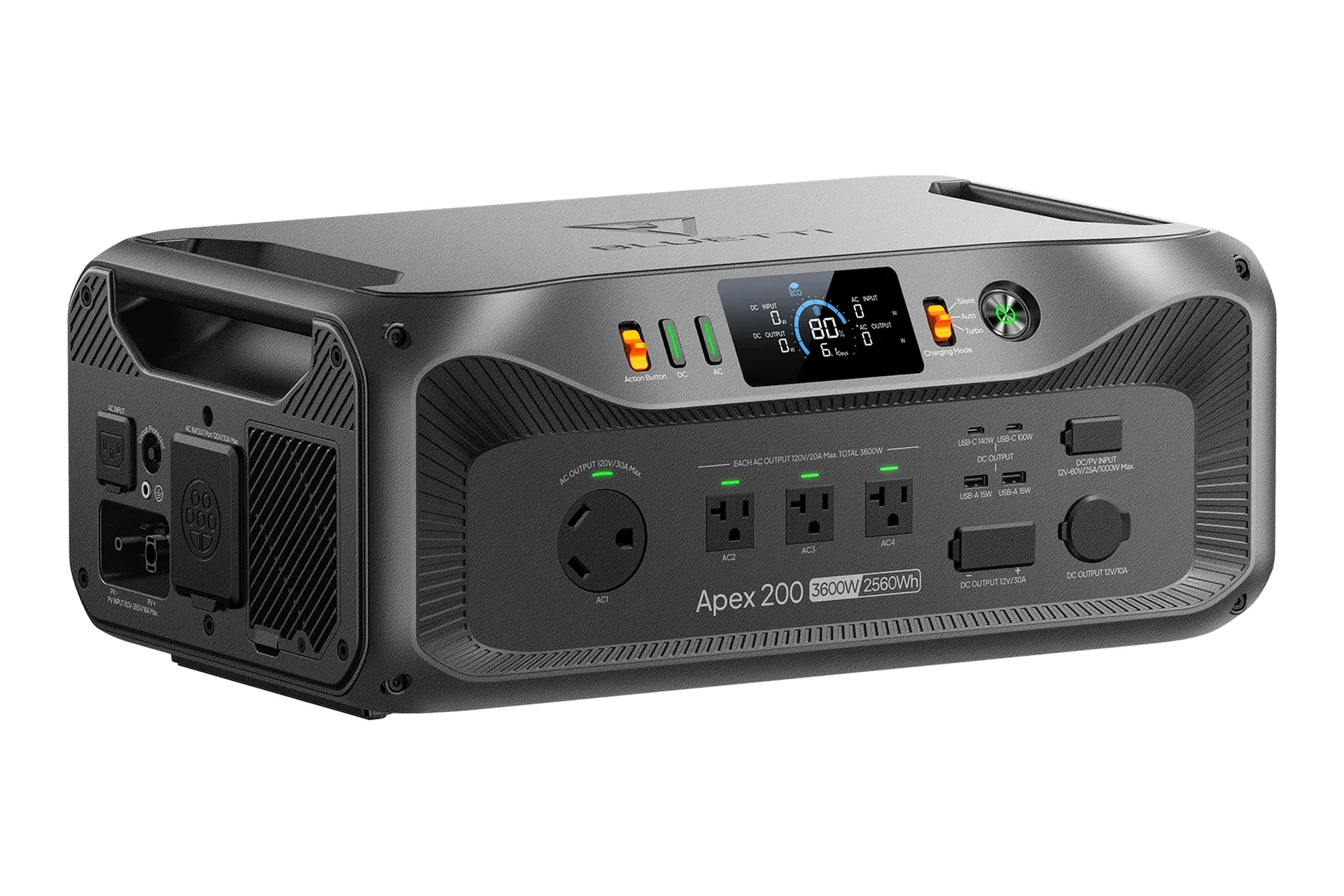
| BLUETTI Apex 200 | 2,560Wh | 3,200W | 3,000W | 59.3 lbs | Largest / most powerful |
The seven picks
Best overall: EcoFlow Delta 2
The Delta 2 is the default recommendation for most buyers: 1,024Wh of LiFePO4 capacity, 1,800W of AC output, 500W of solar input, and a 27 lb weight one person can carry easily. The headline figure is the roughly 80-minute full AC recharge — a short window of grid power or generator time refills it completely. The output covers a full-size fridge, a microwave in short bursts, power tools, and nearly any single appliance. Around $400 on sale at time of writing. Check price
Strengths: fastest wall recharge in the 1kWh class, high output for its size, sensible solar ceiling, strong price per watt-hour when discounted. Trade-offs: 500W of solar is adequate rather than generous, and it lacks the expansion path of the Delta 2 Max — heavy solar users should look at the Elite 100 V2 below.
Fastest recharge: Anker Solix C1000 Gen 2
The Solix C1000 Gen 2 trades the first C1000’s expansion battery for speed and weight: 1,024Wh of LiFePO4 capacity and 2,000W of AC output, rising to 3,000W peak for startup spikes, a higher 600W solar ceiling than the Delta 2, and a 49-minute full AC recharge — the fastest in this guide — in a 24.9 lb case, the lightest full-output station here. Around $530–550 at time of writing. Check price
Strengths: fastest recharge in this guide, strong solar input, full output with peak headroom, and the lightest full-output case here. Trade-offs: no expansion battery, and at street prices it costs more than the Delta 2 and Elite 100 V2 — buy it when recharge speed and carry weight matter more than price per watt-hour.
Best for solar: BLUETTI Elite 100 V2
The Elite 100 V2 shares the 1,024Wh LiFePO4 capacity and 1,800W output of the other 1kWh picks — 2,700W in Powerlifting mode — but its 1,000W maximum solar input is the class-leading figure in this group, double the Delta 2’s ceiling. With a large portable array it can refill in roughly one good sun window and run daytime loads while still gaining charge. At 25.3 lbs it is also lighter than both 1kWh rivals above. Around $430 at time of writing. Check price
Strengths: unmatched solar input in its class, competitive weight, full-size output. Trade-offs: feeding 1,000W of solar means buying and carrying a large panel array, which adds real cost and bulk; mostly wall-charging buyers gain little. For panel-paired setups, see our guide to the best solar generator options.
Lightest 1kWh class: Jackery Explorer 1000 v2
At 23.8 lbs, the Explorer 1000 v2 is the lightest station here over 1,000Wh — and its 1,070Wh of LiFePO4 capacity is in fact the most in the 1kWh group. Its 1,500W AC output covers fridges, CPAP machines, laptops, and lights, though it gives up headroom for high-draw appliances versus the 1,800W models. The 400W maximum solar input is the modest figure in its row. Around $450–500 at time of writing. Check price
Strengths: the weight advantage is real on every carry, and capacity is class-leading. Trade-offs: lower output and the slowest solar ceiling among the 1kWh picks, at a price rarely the lowest. Choose it when weight decides; our best portable power station for camping guide weighs the same trade-off for campers.
Best small / portable: EcoFlow River 2 Pro
The River 2 Pro suits buyers whose station will be carried often and whose loads are modest: 768Wh of LiFePO4 capacity, 800W of AC output, 220W of solar input, and a 17 lb weight that makes it a genuine one-hand carry. That covers phones, lights, a laptop, a fan, and a CPAP night with room to spare — apartment outages, tailgates, and light campsite duty included. Around $300 on sale at time of writing. Check price
Strengths: lightest and cheapest station in this roundup, with the same LiFePO4 longevity as its bigger siblings. Trade-offs: 800W rules out kettles, microwaves, and heating appliances, and 768Wh runs a full-size fridge for hours rather than a day. CPAP users should run their numbers first — our best portable power station for CPAP guide covers humidifier-on and humidifier-off runtimes.
Best for home backup (proven): EcoFlow Delta 2 Max
The Delta 2 Max doubles the formula: 2,048Wh of LiFePO4 capacity, 2,400W of AC output, and 1,000W of solar input, in a 50 lb package that stays movable even if nobody calls it light. It expands to 6,144Wh with extra batteries — the credible path from overnight fridge coverage to multi-day essential-loads coverage without replacing the main unit. This is the established, proven option when the primary job is home backup rather than travel. Around $1,000–1,200 on sale at time of writing. Check price
Strengths: twice the runtime of the 1kWh class, output that clears virtually any single appliance, large solar ceiling, clear expansion path. Trade-offs: weight and price step up sharply, and smaller picks are easier for camping. Our best portable power station for home backup guide maps this tier against outage lengths.
Largest / most powerful: BLUETTI Apex 200
The Apex 200 is the new top-end pick for home-backup-leaning buyers who want the most capacity and output without leaving the portable class: 2,560Wh of LiFePO4 capacity, 3,200W of AC output, and a 3,000W maximum solar input per BLUETTI launch materials — triple the Delta 2 Max ceiling — with expansion available beyond the base unit. At 59.3 lbs it is best treated as semi-portable: moved to where it will sit, then left to work. Pricing is $1,099 launch / $1,399 regular at time of writing. Check price
Strengths: the highest capacity, output, and solar input in this roundup, suited to heavier loads and fast solar recovery in long outages. Trade-offs: heaviest option here, and launch-era specifications carry the usual caution for any newly released model. Buyers who need no more than 2,400W of output are fully served by the Delta 2 Max for less.
How to choose your size
Sizing is arithmetic. List each device, note its watts, and multiply watts by hours needed: a fridge using an effective 150W for 8 hours needs about 1,200Wh; a 40W CPAP for 8 hours needs 320Wh; lights, phones, and a router might add 100Wh. Add the loads, then divide by 0.85 — the usable-capacity rule: between inverter losses and built-in reserve, plan on roughly 85 percent of nameplate watt-hours being usable.
Run your own numbers in our power station size calculator, which applies the same method automatically. For worked examples, read what size portable power station do I need? and our power station size calculator guide. Shortcut: under 800Wh suits devices and lights only, around 1,000Wh is the fridge-capable sweet spot, and 2,000Wh or more is where full-day home backup begins.
What specs actually matter
LiFePO4 cycle life. All seven picks use lithium iron phosphate cells, typically rated for several thousand cycles before capacity falls to 80 percent — several times the lifespan of older lithium-ion stations. For a station cycled daily, that is years versus a decade of service, which is why chemistry outranks small price differences.
Pure sine wave output. Every pick here produces pure sine wave AC, the same clean waveform as grid power — the safe choice for motors, compressors, medical devices, and sensitive electronics. Modified sine wave inverters, found on some ultra-budget models, can cause buzzing, overheating, or refusal to run.
Solar input ceiling. Panel wattage is marketing; the station’s maximum solar input is the limit that counts. A 1,000W array on a 400W ceiling refills at 400W. Match the array to the ceiling, and expect panels to deliver less than their rating outside ideal conditions.
Expansion. Expandable stations — the Delta 2, Delta 2 Max, and Apex 200 here — let capacity grow with need and budget. It is worth paying for when loads may grow, and worth little for a fixed, single job.
Who should skip a portable station
Portable stations power individual devices through their own outlets, and they have honest limits. Whole-house loads — central air conditioning, an electric water heater, an electric stove or dryer — exceed what any unit in this class should do; those needs point to a permanently installed battery system or a fuel generator. Multi-day coverage of high-draw loads is the other poor fit: without substantial solar input, even a 2,560Wh station is a countdown timer for heating or cooking loads. Buyers in either situation should start with the home-backup guide linked above and treat a portable station as the essential-loads layer of a larger plan. For broader background, browse our guides.
Frequently asked questions
How long will a 1,000Wh power station run a refrigerator?
A typical full-size fridge draws roughly 100–200W while its compressor runs, cycling on and off through the day. Applying the 85 percent rule, a 1,024Wh station delivers roughly 850 usable watt-hours — commonly about 8 to 14 hours of fridge coverage depending on model, room temperature, and door openings. A 2,048Wh station doubles that.
Can a portable power station run a CPAP all night?
Yes, comfortably in most configurations. A CPAP without heated humidification often draws 30–60W, so even the 768Wh River 2 Pro covers multiple nights. With a heated humidifier and tube, draw can rise toward 90W and an 8-hour night can use around 700Wh — why CPAP users generally land in the 1kWh class for multi-night trips.
Is LiFePO4 worth it over regular lithium-ion?
For a power station, yes: several times the cycle life, better thermal stability, and a flatter discharge curve, at slightly more weight per watt-hour. Since every pick here already uses LiFePO4, longevity is not a reason to pay more within this group.
How many solar panels do I need?
Enough to approach, but not exceed, the station’s maximum solar input, sized against daily consumption. Plan on 4 to 5 hours of productive sun per day, at well under rated panel wattage. A 1kWh station running a fridge pairs sensibly with 200–400W of panels; larger stations can use 600–1,000W or more.
Can I leave a power station plugged in all the time?
Many home-backup owners do, keeping the station charged and in line with the loads it protects. Follow the manufacturer’s guidance: stations stored unused are generally happiest at partial charge, while stations kept ready for outages are kept near full.
Leave a Reply