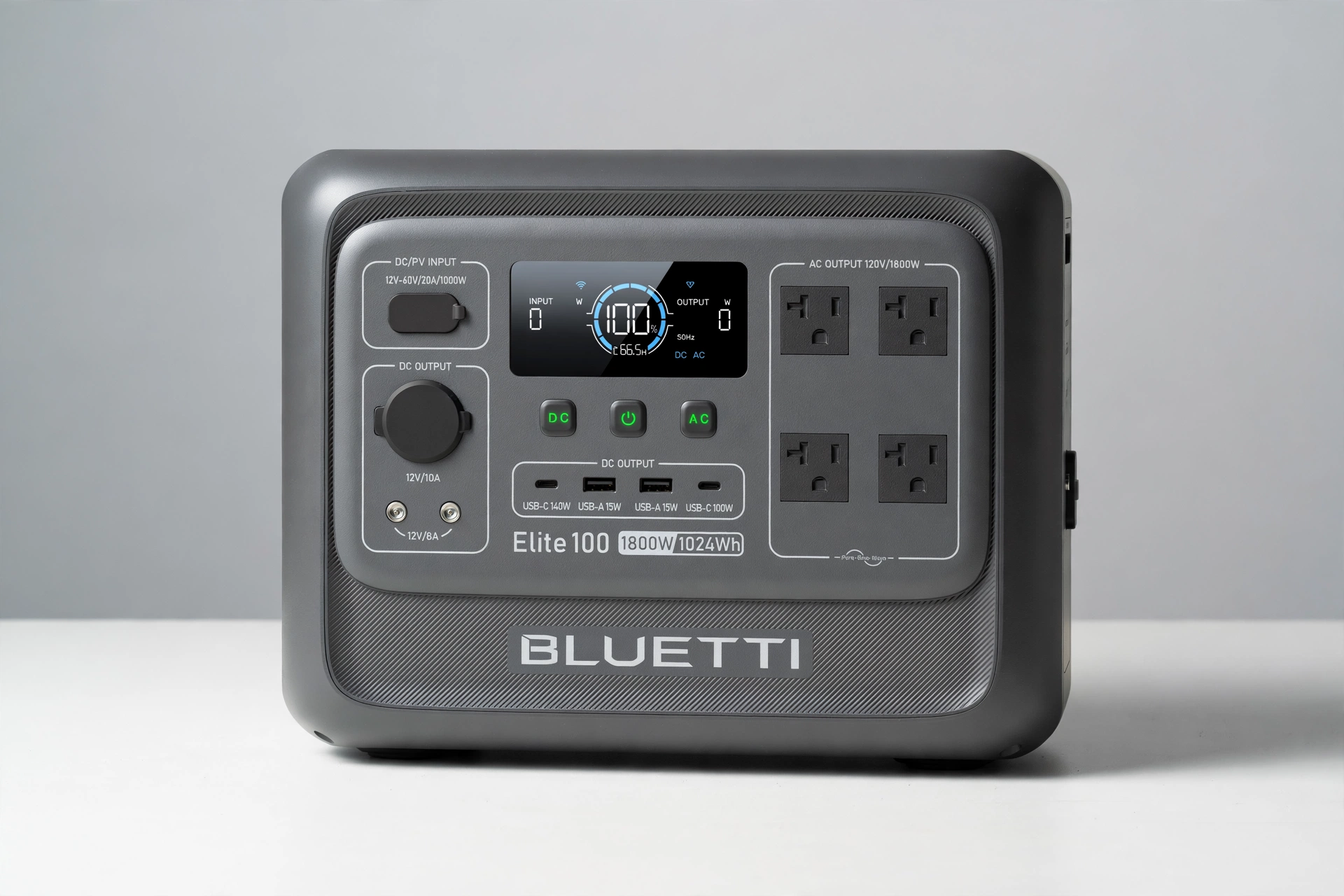
The BLUETTI EB70 and the EcoFlow River Pro are two of the most popular sub-1kWh portable power stations ever sold — similar capacity, similar price, and a similar job: weekend camping, road trips, and light home backup. But they differ in the details that matter: battery chemistry, output power, recharge speed, and expandability. This is a spec-sheet comparison based on manufacturer specifications, not lab testing.
- Quick verdict
- Head-to-head spec table
- Battery chemistry and cycle life
- Output power: what each can actually run
- Recharge speed: wall, solar, car
- Expandability and ecosystem
- Price and value
- Real-world use: a weekend trip
- Who should buy which
- Frequently asked questions
Quick verdict
Buy the BLUETTI EB70 if battery longevity is your priority — its LiFePO4 cells are rated for roughly 2,500+ cycles, several times the River Pro’s older NMC chemistry, and it offers higher continuous output (1,000W vs 600W).
Buy the EcoFlow River Pro if you want the lighter unit with faster wall charging and an expandable ecosystem — it weighs less, charges faster from AC, and pairs with an extra battery to double capacity.
Neither is a bad unit. The EB70 is the longevity pick; the River Pro is the portability and charging-speed pick.
Head-to-head spec table
Per manufacturer spec sheets. Verify current specs before buying — both models have been on the market for several years and revisions occur.
| Spec | BLUETTI EB70 | EcoFlow River Pro |
|---|---|---|
| Capacity | 716Wh | 720Wh |
| Battery chemistry | LiFePO4 | NMC lithium-ion |
| Cycle life (rated) | 2,500+ to 80% | 800 to 80% |
| Continuous output | 1,000W | 600W (1,800W X-Boost) |
| Surge | 1,400W | 1,200W |
| AC recharge | ~3–4 hours (200W input) | ~1.6 hours (660W X-Stream) |
| Max solar input | 200W | 200W |
| Expandable | No | Yes (extra battery → 1,440Wh) |
| Weight | ~21.4 lbs (9.7 kg) | ~16.8 lbs (7.6 kg) |
| AC outlets | 4 | 3 |
| Warranty | 2 years | 2 years |
Battery chemistry and cycle life
This is the single biggest difference between the two, and it favors the EB70 decisively.
The EB70 uses LiFePO4 (lithium iron phosphate) cells rated for 2,500+ cycles to 80% capacity. In practical terms, that is roughly 7 years of daily use before noticeable degradation — and for weekend-only use, effectively a decade.
The River Pro uses older NMC (nickel manganese cobalt) cells rated for about 800 cycles to 80%. That is still several years of weekend use, but it is a fraction of the EB70’s lifespan, and NMC runs hotter and is more sensitive to being stored at full charge.
If you plan to keep the unit for many years or use it heavily, the chemistry gap alone justifies the EB70. If this is a light-use backup unit, the River Pro’s shorter cycle life may never matter to you.
Output power: what each can actually run
The EB70’s 1,000W continuous output covers most camping and light-home loads directly: a mini fridge (~60W), laptop (~60W), phones, lights, a CPAP machine (~30–90W), even a small microwave (~800W) or coffee maker (~800W) one at a time.
The River Pro’s 600W continuous rating is more limiting on paper, but EcoFlow’s X-Boost mode handles resistive loads up to 1,800W by lowering voltage — fine for heaters and kettles, not suitable for sensitive electronics. For typical camping loads (fridge, lights, phones, laptop), 600W is plenty; the gap only shows with power-hungry appliances.
Bottom line: the EB70 runs more things at face value; the River Pro’s X-Boost closes the gap for simple resistive loads.
Recharge speed: wall, solar, car
This category flips in EcoFlow’s favor. The River Pro’s X-Stream charging pulls up to 660W from a wall outlet, refilling 0–80% in about an hour — among the fastest in this size class when it launched, and still quick today.
The EB70 charges at roughly 200W from the wall, taking 3–4 hours for a full charge. That is slow by modern standards and the EB70’s weakest spec.
Solar is a tie at 200W max each — adequate for topping up at camp but not fast. Car charging on both is the usual slow 12V trickle. If fast turnaround between uses matters (back-to-back weekend trips), the River Pro wins comfortably.
Expandability and ecosystem
The River Pro pairs with EcoFlow’s extra battery to double capacity to 1,440Wh — a genuine upgrade path if your needs grow. It also slots into EcoFlow’s broader ecosystem of panels and accessories.
The EB70 is a closed unit: 716Wh is what you get, permanently. BLUETTI’s larger modular systems (AC200/AC300 series) are a separate purchase, not an upgrade path from the EB70.
For buyers who might outgrow 700Wh, the River Pro’s expandability is a real advantage. For buyers who know 700Wh is enough, it is irrelevant.
Price and value
Both units have been heavily discounted as newer models arrived — street prices move constantly, so check current pricing rather than list. Historically the EB70 listed around $599 and the River Pro around $599, with both frequently dropping to the $400–500 range on sale.
Value math: the EB70 gives you ~3x the cycle life at a similar price, which is the better long-term value if you keep units for years. The River Pro gives you faster charging and expandability, which is the better value if those features match your use.
Real-world use: a weekend trip with each
Specs tell half the story. Here is how a typical weekend plays out on each unit.
With the EB70: Friday evening you load the car — 21 lbs, one trip. At camp you run a 12V fridge (~45W), charge two phones, and run LED string lights (~15W) through the evening. Total overnight draw: roughly 300Wh. Saturday you do it again, plus a laptop charge (~60Wh) and a coffee maker run (~800W for 5 minutes, ~70Wh). By Sunday morning you have used roughly 700Wh of 716Wh — the unit is nearly empty but it covered the whole weekend. You drive home and plug it in; it takes most of the afternoon to refill.
With the River Pro: the same weekend uses the same energy, but the lighter 17-lb unit is easier to carry and the faster charging means a one-hour lunch stop at a café with a wall outlet meaningfully tops it up. If you own the extra battery, the weekend never touches the limit at all.
The practical difference: the EB70 asks less of you (no battery anxiety, longer-lived cells) but gives back slower recharging. The River Pro asks you to think about charging opportunistically but rewards it with speed.
Who should buy which
- Buy the BLUETTI EB70 if: you want the longest-lasting battery, higher continuous output, and do not mind slower wall charging. The set-it-and-forget-it pick.
- Buy the EcoFlow River Pro if: you want the lighter unit, fastest recharging, and a path to double capacity later. The active-weekender pick.
One more consideration: both are previous-generation models. If buying new today, also compare their successors — the BLUETTI EB3A and EcoFlow River 2 Pro — which updated chemistry and charging across the board. Our brand comparison covers the current lineups.
Frequently asked questions
Is the BLUETTI EB70 better than the EcoFlow River Pro?
For battery longevity and continuous output, yes. For charging speed, weight, and expandability, the River Pro wins. Match the winner to your priorities.
Can either run a full-size fridge?
Briefly. A full-size fridge draws ~150W running with higher startup surges — both units can run one for a few hours, but 700Wh-class stations are better suited to mini fridges and electronics. See our sizing guide.
Are these still worth buying in 2026?
At clearance prices, yes — the underlying hardware is solid. But compare against the EB3A and River 2 Pro first; the newer models improved charging speed and (in EcoFlow’s case) switched to LiFePO4.
Read next
- BLUETTI vs EcoFlow vs Jackery — the full brand comparison.
- What Size Portable Power Station Do I Need? — sizing math.
- Best Portable Power Station for Camping — current picks.
Leave a Reply