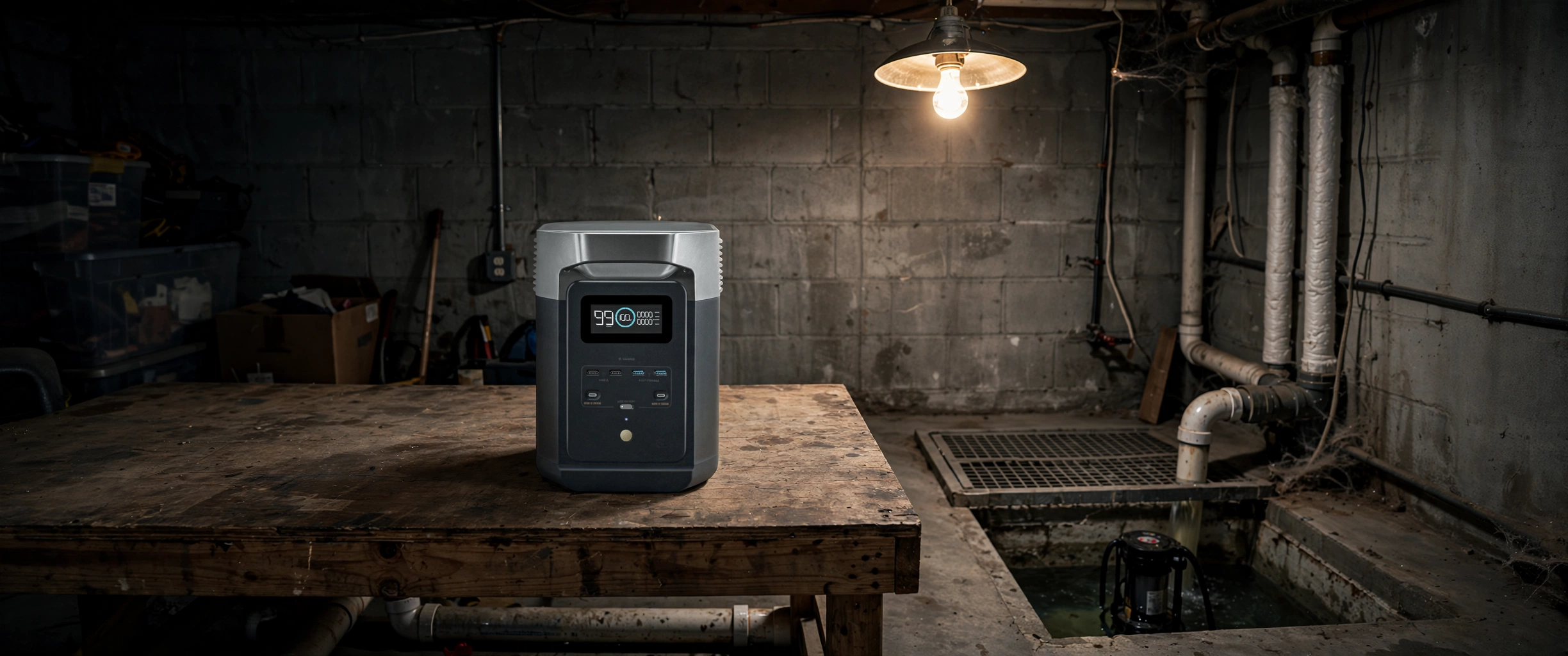
A sump pump is the appliance that floods your basement if it stops — so asking whether a portable power station can run one is really asking whether you can trust it when the stakes are highest. The honest answer: only the largest stations can, and even then a gas generator is usually the better tool for this job. Here is the full picture.
- What a sump pump actually draws
- The startup surge problem
- Runtime math: how long would it last
- The honest answer
- Using a station as bridge backup
- What to buy if you go this route
- Frequently asked questions
What a sump pump actually draws
Residential sump pumps are thirsty. Typical specs:
- 1/3 HP pump: 800–1,000W running
- 1/2 HP pump: 1,000–1,500W running
- 3/4 HP pump: 1,500–2,000W running
Check your pump’s label for its rated wattage or amperage (amps × 120 = watts). Most suburban homes have a 1/3 or 1/2 HP unit. If you do not know yours, assume 1,000W for planning — it is the most common size.
The startup surge problem
This is the dealbreaker for most stations. An electric motor draws 3–7 times its running wattage for a fraction of a second when it starts — this is called locked-rotor current. A 1,000W sump pump can surge to 3,000–5,000W at startup.
Most 1000Wh-class portable power stations output 1,500–1,800W continuous with 2,400–3,000W surge ratings. That is not enough to reliably start a 1/2 HP sump pump. The inverter will trip on overload, the pump will stall, and the cycle repeats until the station’s protection shuts it down.
To start a typical sump pump reliably, you need a station rated for at least 2,400W continuous output — and even then, verify the surge rating clears your pump’s locked-rotor draw. This puts you in the 2000Wh+ class at minimum.
Runtime math: how long would it last
A sump pump does not run continuously — it cycles as water accumulates. During a heavy storm, expect the pump to run 25–50 percent of the time (15–30 minutes per hour). Runtime math:
Hours of pump-on time = (Station Wh × 0.85) ÷ Pump watts
| Station | 1,000W pump (pump-on time) | Wall-clock at 30% duty |
|---|---|---|
| 1,000Wh | ~0.85 hours | ~2.8 hours |
| 2,000Wh | ~1.7 hours | ~5.7 hours |
| 3,000Wh | ~2.6 hours | ~8.5 hours |
During an active storm with heavy inflow, a 2000Wh station buys you roughly half a workday of sump coverage. That is meaningful — but it is not the multi-day resilience most people imagine when they buy backup power.
The honest answer
For sump pump backup, a gas or dual-fuel generator in the 3,500–7,500W range is the better tool. It starts the pump without breaking a sweat, runs for 8–12 hours on a tank of gas, and costs less per watt than any battery station. If your basement floods when the pump stops, this is not the place to economize on capability.
The scenarios where a portable power station makes sense for a sump pump:
- Short outages (under 6 hours) where a 2000Wh+ station covers the gap
- As a bridge while you set up a generator, or while you are away and a generator cannot auto-start
- Where generators are impractical — condos, townhouses with HOA restrictions, or noise ordinances
- Paired with a battery-backup sump pump system as a secondary layer
Using a station as bridge backup
The smartest setup: a 2000Wh-class station plugged into the sump pump through a transfer arrangement, kept charged and ready. When the grid drops, the station carries the pump for the first several hours. If the outage stretches longer, you fire up the generator and let the station recharge.
Some stations offer UPS (uninterruptible power supply) mode with sub-20ms switchover. In UPS mode the station sits between the wall outlet and the pump; when grid power fails, the station takes over without the pump noticing. Verify the switchover speed on the spec sheet — a pump that loses power for even a few seconds during a storm is a pump that is not pumping.
One caution: do not run a sump pump from a station in an enclosed space with a gas generator nearby. Carbon monoxide and flooded basements are a lethal combination. Keep combustion equipment outside and far from windows.
What to buy if you go this route
This recommendation is based on manufacturer specifications, not lab testing yet. For sump pump duty you need 2,400W+ continuous output and 2,000Wh+ capacity — there is no way around those numbers.
The EcoFlow Delta 2 Max Check price (2,048Wh, 2,400W continuous, 3,400W X-Boost) is the minimum viable option: enough output to start most 1/2 HP pumps and enough capacity for several hours of cycling. Expandable to 6,144Wh with extra batteries if you need longer coverage.
If your pump is 3/4 HP or your inflow is heavy, step up to the Delta Pro class (3,600W output) or accept that a generator is the right answer. For whole-home outage planning beyond the sump pump, see our power outage guide.
Sizing for your specific pump
Not all sump pumps are equal, and the difference between a 1/3 HP and 3/4 HP unit is the difference between “a big station might work” and “forget it.” Here is how to get your exact numbers:
- Read the motor label. Look for running amps and locked-rotor amps (LRA). Running watts = running amps × 120. Surge watts = LRA × 120.
- Measure with a clamp meter. A $30–50 clamp meter around one conductor during startup gives the real surge number — more reliable than labels on older pumps.
- Check the duty cycle. During a storm, time how long the pump runs per hour. A pump running 10 minutes per hour (17% duty) needs far less energy than one running 30 minutes per hour (50%).
Worked example: a 1/2 HP pump labeled 9 running amps (1,080W) with 28 LRA (3,360W surge), running 20 minutes per hour during heavy rain. Minimum station: 2,400W+ continuous output (clears the surge with margin), 2,000Wh+ capacity. Expected coverage: (2000 × 0.85) ÷ 1080 ≈ 1.6 pump-hours ≈ 4.7 wall-clock hours at 33% duty.
If your pump’s surge exceeds 4,000W — common on 3/4 HP units — no portable station is a responsible choice. That is generator territory, full stop.
Frequently asked questions
Can a Jackery 1000 run a sump pump?
Almost certainly not. Its 1,500W continuous output cannot reliably clear a sump pump’s startup surge. Do not try it during a storm — test beforehand if you must, but expect the inverter to trip.
What about a battery-backup sump pump system?
Dedicated 12V battery-backup sump systems (like Basement Watchdog) are designed exactly for this and are cheaper than a power station. They are the best primary backup; a power station is a secondary layer.
How do I know my pump’s startup surge?
Check the motor label for locked-rotor amps (LRA). Multiply LRA by 120V for the surge wattage. If the label is unreadable, a clamp meter during startup gives the real number.
Can I use a station and generator together?
Yes — station as the instant-on bridge, generator for sustained runtime. Just never backfeed: use a proper transfer switch or keep the pump’s plug physically moved between sources.
Leave a Reply