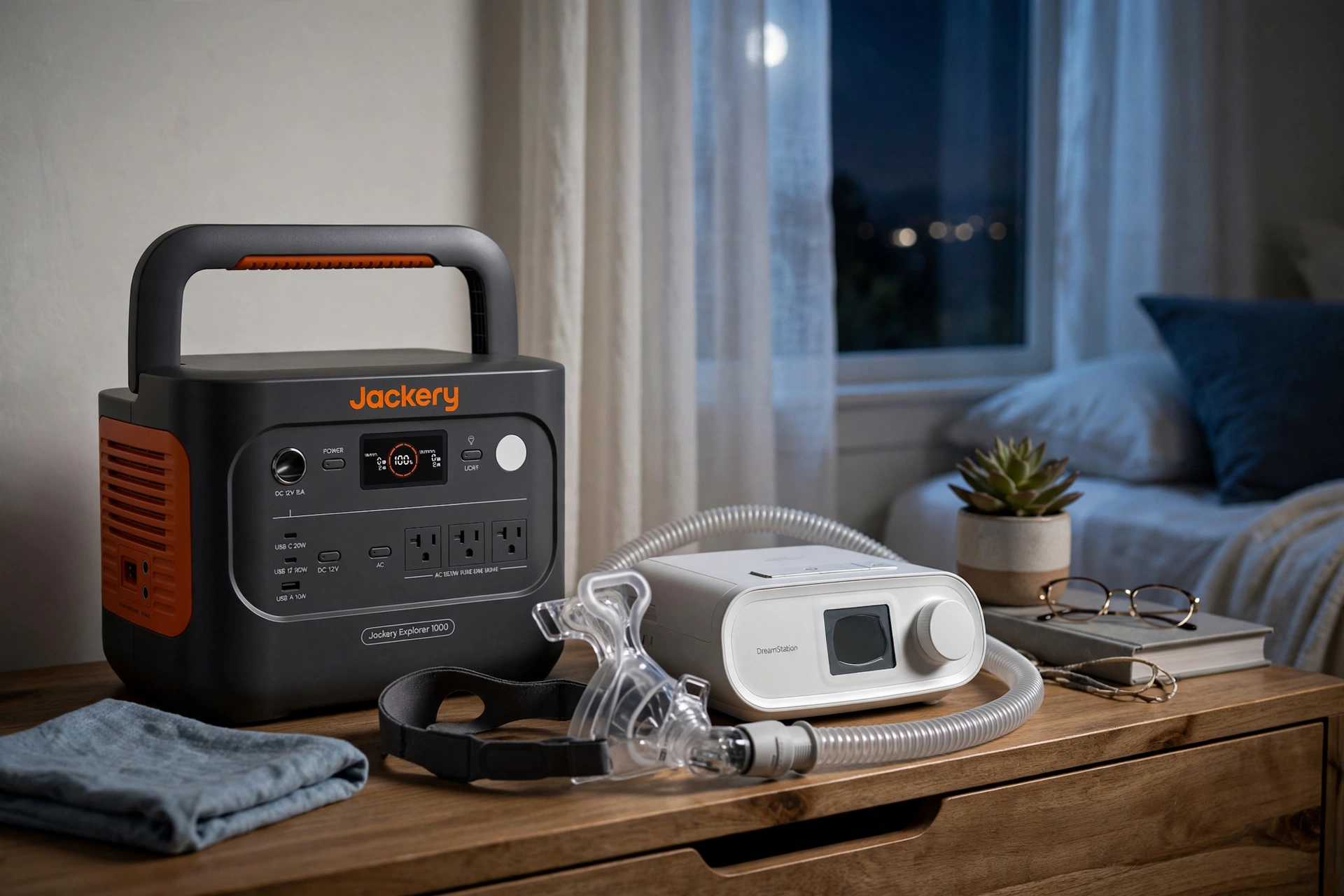
Not all CPAP machines draw the same power — and the difference between a ResMed AirSense 11 and an older Philips Respironics unit can mean an extra night of runtime from the same battery. This guide focuses on the machine side of the equation: how specific CPAP models differ in power draw, how to calculate runtime for your exact setup, and the DC adapter trick that stretches any station further. For the full station-by-station buying guide, see our best portable power station for CPAP main guide.
- How much power different CPAP machines draw
- The humidifier: the single biggest variable
- Runtime math for your exact machine
- The 12V DC adapter trick
- Using a station as outage backup for nightly therapy
- Station picks for CPAP machines (spec-based)
- Traveling with a CPAP machine and power station
- Frequently asked questions
How much power different CPAP machines draw
CPAP power draw varies more than most buyers expect. The machine’s pressure setting, motor efficiency, and especially the humidifier all move the number. Here are typical ranges per manufacturer specs and owner measurements.
| Machine | Without humidifier | With heated humidifier |
|---|---|---|
| ResMed AirSense 10 / 11 | ~25–40W | ~70–104W |
| Philips Respironics DreamStation | ~30–50W | ~80–100W |
| ResMed AirMini (travel) | ~15–27W | N/A (waterless humidification) |
| Fisher & Paykel SleepStyle | ~30–45W | ~75–100W |
The pattern is consistent: the machine itself sips power (15–50W), and the heated humidifier roughly doubles or triples it. The ResMed AirMini deserves special mention — as a travel unit with waterless humidification, it is the most power-frugal option on this list, which is why frequent travelers pair it with smaller stations.
Check your machine’s power brick label for its rated wattage — that is the ceiling, not the typical draw. Real-world consumption usually runs 50–70% of the brick’s rating.
The humidifier: the single biggest variable
If you take one thing from this article, take this: the heated humidifier dominates your power budget. A machine drawing 30W without it can draw 90W with it. Over 8 hours, that is the difference between 240Wh and 720Wh per night — the difference between a 300Wh station and a 1,000Wh station.
During an outage or a camping trip, consider sleeping one night without the humidifier (or with passive, unheated humidification) to see if you tolerate it. Many users find they can. If you can, you can buy a dramatically smaller, cheaper, lighter station. If you cannot — and plenty of people genuinely cannot — size for the humidified number and do not feel bad about it. Comfort during therapy is not optional.
Runtime math for your exact machine
Formula: (machine watts × sleep hours ÷ 0.85 inverter efficiency) = Wh needed per night. Then divide station capacity by that number for nights of runtime.
Worked example — ResMed AirSense 11, no humidifier, 8 hours: 35W × 8 ÷ 0.85 = ~330Wh per night. A 1,024Wh station (like the EcoFlow Delta 2) delivers about 3 nights.
Same machine with heated humidifier: 85W × 8 ÷ 0.85 = ~800Wh per night. That same 1,024Wh station now delivers just over 1 night. The humidifier more than halved your runtime.
Travel example — ResMed AirMini, 8 hours: 20W × 8 ÷ 0.85 = ~190Wh per night. A 1,024Wh station stretches past 5 nights. This is why the AirMini plus a mid-size station is the classic travel combination.
When in doubt, measure: a $20 plug-in watt meter between your machine and the wall gives you your exact draw overnight. One night of measurement beats any estimate.
The 12V DC adapter trick
Your CPAP runs on DC internally. The wall plug converts AC to DC; a power station’s inverter converts its DC battery back to AC. That round trip wastes 10–20% of your battery as heat.
A manufacturer DC adapter — ResMed makes one for the AirSense 10/11, Philips for the DreamStation, and third parties cover most major brands at roughly $30–90 — plugs your machine straight into the station’s 12V car-style outlet, skipping the inverter entirely. Owner reports consistently show 20–30% longer runtime: a station that delivered two nights on AC approaches three on DC.
Two practical notes. First, verify the adapter matches your exact machine model — connectors differ between brands and generations. Second, the station’s 12V outlet must supply enough current; most current 1kWh-class stations provide 10A (120W), which covers any CPAP, but check the spec sheet on smaller units.
Using a station as outage backup for nightly therapy
The most reliable CPAP-outage setup: keep the station plugged into the wall between the outlet and your machine, in UPS mode. When the grid drops at 2 a.m., the station switches to battery in 10–20ms — faster than your machine can notice — and therapy continues uninterrupted.
For this to work, the station needs a fast-enough switchover (under 20ms; check the spec sheet) and enough capacity for a full night plus margin. A 1,000Wh-class station covers any single-humidifier machine for one night with room to spare; two nights needs either no humidifier or a larger station.
One maintenance note: a station sitting at 100% charge indefinitely wears its battery faster. LiFePO4 chemistry handles this far better than older NMC — buy a current-generation LiFePO4 model if UPS duty is the plan, and expect to replace the unit on the battery’s cycle-life schedule, not sooner.
Station picks for CPAP machines (spec-based)
Based on manufacturer specifications and published owner data, not lab testing. For the full buying guide with detailed pick write-ups, see our best portable power station for CPAP main guide. Summary:
- Best all-rounder: EcoFlow Delta 2 — 1,024Wh LiFePO4, ~3 dry nights or 1 humidified night, fastest recharge in its class. Check price
- Simplest to live with: Jackery Explorer 1000 v2 — 1,070Wh LiFePO4, 5-year warranty, dead-simple interface for 2 a.m. outages. Check price
- Best for solar refills: BLUETTI Elite 100 V2 — 1,024Wh LiFePO4, 1,000W solar input for multi-day off-grid therapy. Check price
- Best for extended backup: EcoFlow Delta 2 Max — 2,048Wh for 2+ humidified nights or multi-night dry coverage. Check price
Traveling with a CPAP machine and power station
Two constraints dominate travel: weight and airline rules. A 1,000Wh station weighs 24–30 lbs — fine for car camping, noticeable as luggage. For air travel, lithium batteries over 100Wh are restricted in carry-on (up to 160Wh with airline approval), which rules out full-size stations entirely. Frequent flyers pair a ResMed AirMini with a sub-160Wh power bank or rely on the aircraft/hotel outlet.
For road trips, the 12V car charger input on most stations means driving refills the battery — arrive at camp with a full station without ever touching a wall outlet.
Frequently asked questions
Will a portable power station damage my CPAP machine?
No, provided the station uses a pure sine wave inverter — which every reputable current model does. Modified sine wave inverters (found only on very cheap or very old units) can harm CPAP motors. Verify “pure sine wave” on the spec sheet.
How many nights will a 1000Wh station run my CPAP?
Roughly 3 nights without a humidifier, or 1 night with a heated humidifier, for a typical full-size machine. A travel machine like the AirMini stretches past 5 nights. Use the formula above with your machine’s actual wattage for a precise answer.
Do I need a special adapter?
Not strictly — the station’s AC outlets run any CPAP directly. But a 12V DC adapter ($30–90) extends runtime 20–30% by skipping the inverter, which is the cheapest capacity upgrade you can buy.
Read next
- Best Portable Power Station for CPAP — the full station-by-station buying guide.
- What Size Portable Power Station Do I Need? — the watt-hour math.
Leave a Reply