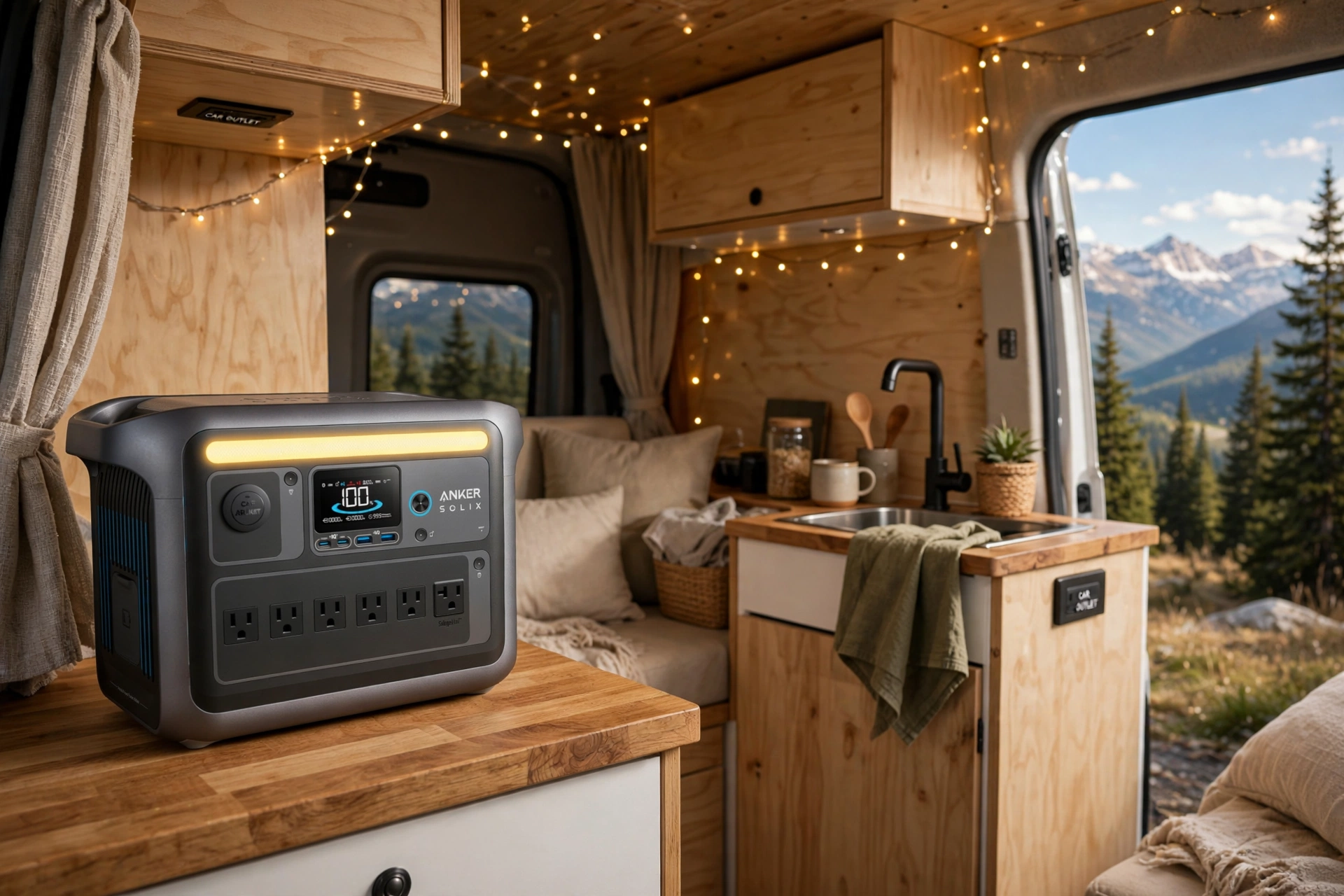
Van life runs on electricity: the fridge that keeps food cold, the lights after dark, the laptop for remote work, the fan on hot nights. A portable power station is the simplest way to get it — no permanent wiring, no roof full of panels on day one. But buy too small and the fridge dies at 2 a.m.; buy too big and you are hauling weight and spending money you did not need to. Here is how to size it right.
- What van lifers actually power
- The sizing math
- Three real scenarios
- Pairing with solar
- Spec-based picks for van life
- Frequently asked questions
What van lifers actually power
Every van build is different, but the electrical loads cluster around the same short list. Realistic draws:
| Device | Typical draw | Daily use | Daily Wh |
|---|---|---|---|
| 12V fridge (45L) | 45W avg | 24h (cycling) | ~500Wh |
| LED lights | 10W | 4h | 40Wh |
| Laptop | 60W | 4h | 240Wh |
| Vent fan (low) | 15W | 8h | 120Wh |
| Phone charging | 10W | 3h | 30Wh |
| Diesel heater fan | 20W | 6h | 120Wh |
The fridge dominates — roughly half the daily budget in most builds. Everything else is rounding. If you are still choosing a fridge, a 12V compressor fridge (not a thermoelectric cooler) is non-negotiable for efficiency: thermoelectric units draw 3–4× the power for worse cooling.
The sizing math
Add your daily watt-hours, then apply two adjustments:
1. Inverter efficiency: divide by 0.85. A 1,050Wh daily load needs ~1,235Wh of station capacity.
2. Autonomy days: multiply by the number of cloudy/stationary days you want to survive without charging. Two days of autonomy is the practical minimum for van life — weather happens.
Example: 1,050Wh daily × 2 days ÷ 0.85 = ~2,470Wh of station capacity for full two-day autonomy. That is a lot — which is why most van lifers pair a 1000Wh station with solar rather than buying 2500Wh of battery.
For the complete methodology, see our sizing guide — the same math applies, with worked examples.
Three real scenarios
Weekend warrior (2–3 days, drives daily)
Daily load ~600Wh (fridge + lights + phones). The alternator or a short drive recharges via 12V car input. A 500–768Wh station suffices — light, cheap, and easy to move between van and campsite.
Part-time van lifer (weeks at a time, mixed driving)
Daily load ~1,000Wh (add laptop + fan). A 1000Wh station + 200W solar is the classic setup: solar covers the daily load in decent sun, driving tops up the rest. This is where most people land.
Full-time off-grid (stationary for days)
Daily load ~1,200Wh+. You need 2000Wh+ of capacity and 400W+ of solar, or accept generator/shore-power top-ups. At this level, compare the cost against a built-in lithium + inverter system — permanent installs start making financial sense around 2–3kWh.
Pairing with solar
Solar changes the equation more than extra battery does. A 200W panel in good sun produces roughly 800–1,000Wh per day — nearly covering a typical van lifer’s entire daily load. The station becomes a buffer rather than the whole supply.
What to check on the spec sheet:
- Max solar input (watts): the ceiling on how fast panels can refill the station. 400W+ is comfortable; 200W is workable.
- MPPT controller: standard on all reputable stations now — extracts maximum power from panels as light changes.
- Panel voltage compatibility: most stations accept 12–60V. Standard “12V” rigid panels (~18V open-circuit) work; check before buying used panels.
- Portable vs. rigid panels: portable folding panels suit weekend use; rigid roof-mounted panels suit full-timers. Both feed the same input.
Roof space is the real constraint in a van — most roofs fit 200–400W of rigid panels. Size the station to the panels, not the other way around.
Spec-based picks for van life
These are based on manufacturer specifications, not lab testing yet. For van life, the deciding factors are solar input (refill speed off-grid), weight (you carry it), and 12V output quality (fridge efficiency).
The BLUETTI Elite 100 V2 Check price (1,024Wh, 1,000W max solar input) is the solar-first pick: its 1,000W solar ceiling is double most competitors, so it refills dramatically faster from the same roof. At ~25 lbs it is manageable to move in and out of the van.
The EcoFlow Delta 2 Check price (1,024Wh, 1,800W output, 500W solar) is the value pick: usually cheaper on sale, faster wall charging when you do hit shore power, and a deeper accessory ecosystem (including an 800W alternator charger that refills from the engine far faster than a 12V socket).
Skip the 500Wh class if you run a fridge full-time — the daily cycling will have you charging constantly. And if your build is heading toward 2kWh+, price a permanent install before buying a second portable unit.
Weight and space: the van constraints
A van is a small space with a strict weight budget. Every pound of battery is a pound of water, food, or gear you cannot carry — and every cubic inch matters in a build where the bed is also the garage.
- 500Wh class: ~13–15 lbs, roughly shoebox-sized. Fits under a bench seat. Easy to carry to a picnic table.
- 1000Wh class: ~24–28 lbs, roughly a small cooler. Fits in a cabinet or under a fixed bed. Manageable to move but you will not want to do it daily.
- 2000Wh class: ~48–55 lbs, roughly a large cooler. Effectively permanent once installed — plan the mounting location.
Secure the station for driving. A 25-lb battery becoming a projectile in a sudden stop is dangerous. Bungee cords are the minimum; a dedicated compartment with a strap is better. Never mount where it blocks ventilation — stations need airflow around their cooling vents, especially when charging.
Altitude note: if your travels take you above ~6,500 feet, check the manufacturer’s altitude rating. Fan-cooled electronics lose cooling efficiency in thin air; most stations are rated to 6,500–10,000 feet.
Shore power and hybrid setups
Not every night is off-grid. Campgrounds with hookups, friends’ driveways, and public EV chargers (with the right adapter) all offer shore power — and a fast-charging station turns a one-hour stop into a full battery.
The EcoFlow Delta 2’s ~80-minute 0–100% wall recharge shines here: pull into a campground with hookups, plug in while you set up camp, and you are full before dinner. Slower-charging stations need an overnight hookup for the same result.
The hybrid approach many experienced van lifers settle on: a 1000Wh portable station for daily cycling plus a small fixed solar array (200W) on the roof. The panels handle the baseline load on sunny days; the station’s fast charging covers the gaps when you find shore power. Total system cost stays well under a full permanent lithium install, and you keep the flexibility to pull the station out for non-van use — backyard parties, power outages at home, loaning to a friend.
That flexibility is the portable station’s real advantage over a built-in system. A $500–800 portable unit that serves the van and the house and the campsite beats a $2,000 permanent install that only serves the van — unless you are full-time and the daily cycling justifies the investment.
Frequently asked questions
Can I charge while driving?
Yes — via the 12V car socket (slow, ~100W) or a DC-DC alternator charger (fast, up to 800W on supported models). The alternator charger is one of the best van-life upgrades available.
Do I need pure sine wave?
Yes for anything with a motor or sensitive electronics — which is everything in a van. All reputable current stations are pure sine wave; just verify before buying off-brand.
Can I run an induction cooktop?
A small 1,200W induction plate works on a 1,800W-output station, but it eats ~100Wh per meal. Most van lifers cook with propane and save the battery for the fridge.
What about winter?
LiFePO4 stations should not charge below freezing — most have low-temperature protection that simply refuses. Keep the station inside the heated living space, not in an uninsulated garage bay.
Read next
- Portable Power Station for Camping — the complete camping guide the van setup builds on.
- Best Portable Power Station for Camping — spec-based picks, including lightweight options.
Leave a Reply