A solar generator earns its name in the field, not at the wall outlet. The station is only half the system — the folding panel propped against a camp chair, angled into the sun and re-aimed twice a day, is what turns a one-night battery into a week of power. This guide starts where camping power actually starts: pairing panels with stations, chasing sun across a campsite, and running the cable from a sunny clearing to a shaded tent. Then we size the loads, pick the combinations that work, and cover the weather reality nobody puts on the box. It is the solar-first companion to our broader portable power station for camping guide.
- Panel pairing in the field
- Sizing a camp load
- Panel sizing: weekend vs week-long
- Station + panel picks
- Shade and weather reality
- The quiet-camping case
- Frequently asked questions
GadgetPreview is reader-supported. When you buy through links on our site, we may earn an affiliate commission.
Panel pairing in the field
Camping solar is a daily ritual, and it helps to know the moves before the first trip. You unfold the panel, prop it on its kickstands, and angle it toward the sun — flatter at midday, tilted morning and evening. A panel aimed well at 10 a.m. is aimed badly by 3 p.m., so repositioning two or three times a day is not fussiness; it is easily 20–30% more energy from the same panel.
The cable run is the campsite puzzle. Your tent wants shade; your panel wants the sunniest patch in the site, which might be 15 feet away by the fire ring or out on the parking pad. Portable panels ship with cables long enough for a sensible run, and extension cables exist for awkward sites, but every plan should start with: where does the panel sit at 9 a.m., at noon, and at 5 p.m.? Walk it mentally before you pack. The station itself stays by (or in) the tent vestibule, shaded and dry, with the cable snaking out to the panel.
Match the panel to the station’s max solar input. That spec caps what any panel can deliver. A 400W panel connected to a station with 220W max solar input behaves like a 220W panel — the extra watts are wasted money and extra weight. Every pairing in this guide respects the cap, and our camping power station calculator will sanity-check a combination before you buy it.
Sizing a camp load
Camp loads are smaller than home loads, but they add up across a long evening. A realistic light-camp day looks like this:
- LED camp lights: a 10W string or lantern run 5 hours = 50Wh.
- Phones: about 15Wh per full charge; two phones = 30Wh.
- Small fan: 25W for 5 hours = 125Wh — the difference between sleeping and sweating in July.
- Headlamps, speaker, camera batteries: call it 30–50Wh of odds and ends.
That is roughly 250Wh per day before the big decision: the electric cooler. A 12V compressor cooler draws around 45W while running and cycles like a tiny fridge, averaging roughly 400–550Wh across a hot day. It replaces ice runs and melted sandwiches, but it more than doubles the camp’s daily appetite — total draws of 700–900Wh per day are normal for a cooler-equipped family camp. Size the system for the cooler if you are bringing one; it, not the phones, sets the budget. (Medical devices are their own sizing problem — if a CPAP is part of your kit, that has a dedicated guide in our solar generator coverage, linked from the picks below.)
Panel sizing: weekend vs week-long
The site-wide solar math: panel watts × peak sun hours × 0.75 real-world factor = watt-hours recovered per day. Five peak sun hours is a fair planning figure for a decent summer day; shade and weather get their own section below.
Weekend trips (2–3 nights). You arrive with a full station, so the panel only has to slow the drain or cover one day’s consumption. A 200–220W panel harvests about 750–825Wh per sunny day — more than a light camp uses, and enough to keep a cooler camp roughly level for a weekend. For a two-night light camp, honestly, the panel is optional; for three nights or any cooler use, bring it.
Week-long trips. Now the panel must fully replace each day’s consumption, every day, with a buffer for a grey one. A cooler-equipped camp burning 800Wh/day wants at least 350–400W of panels: 400W × 5 × 0.75 = 1,500Wh/day, which covers the load and banks surplus on good days. That also means choosing a station whose max solar input can accept the array — 400W of panels on a 220W-input station strands you at weekend math no matter how long you stay. To model other trip lengths and load mixes, the power station size calculator does the arithmetic in one pass.
Station + panel picks
These pairings are based on manufacturer specifications, since our test lab is not running yet. Each one respects the station’s solar input cap and targets a full daily replacement of the load it is sized for.
Light camps: EcoFlow River 2 Pro + EcoFlow 220W panel
The River 2 Pro’s 768Wh capacity and 220W max solar input make it the natural partner for EcoFlow’s 220W folding panel — the pairing uses the station’s full input without wasting a watt. At 17 lbs for the station, the whole kit is genuinely portable between car and site. A sunny day returns roughly 800Wh, covering a lights-phones-fan camp entirely and stretching a light cooler camp across a long weekend. Around $300 on sale for the station. Check price
Family camps: EcoFlow Delta 2 + EcoFlow 400W panel
The Delta 2 brings 1,024Wh and a 500W max solar input, so a single 400W portable panel runs near the cap and can refill the station in about 3.5 peak sun hours. That 1,500Wh/day harvest is the family-camp number: cooler, lights, four phones, and a fan, sustained indefinitely in decent weather. The ~80-minute AC recharge is the escape hatch — one powered campsite night or a lodge stop resets you to full. Around $400 on sale. Check price
Maximum solar headroom: BLUETTI Elite 100 V2 + BLUETTI PV350
If your camps are long and your sites are sunny, the Elite 100 V2 is the solar specialist: same 1,024Wh class as the Delta 2, but a 1,000W max solar input — double the ceiling. Pair it with BLUETTI’s 350W PV350 panel for about 1,300Wh/day, or run two panels toward the cap when a week-long trip demands it. At 25.3 lbs it is also the lightest of the 1kWh stations here. Around $430. Check price
Bundle simplicity: Jackery Explorer 1000 v2 + SolarSaga panels
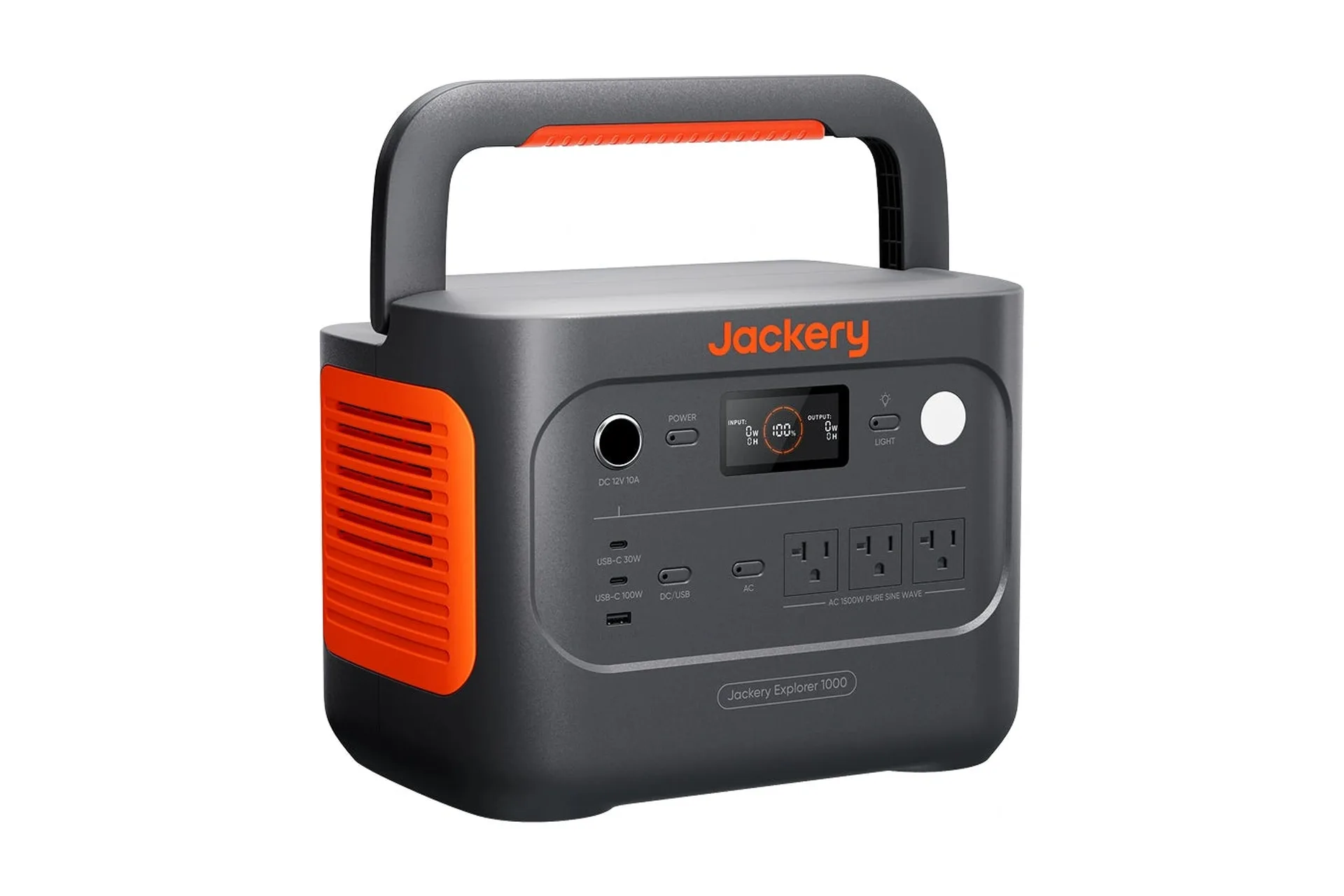
Jackery’s pitch is that the bundle just works: the Explorer 1000 v2 (1,070Wh, 400W max solar input) pairs with SolarSaga 200 panels — two of them reach the input cap — with matched connectors and the least setup friction in the category. You give up some solar ceiling versus the BLUETTI, and in exchange the whole system feels like one product. For campers who value painless over maximum, that trade is often right. Around $450–500. Check price
For the station-only rankings behind these pairings, see our best portable power station for camping roundup and the overall best solar generator list. And if your camp power is really about one specific overnight load, our solar generator guide for CPAP camping sizes that case separately.
Shade and weather reality
Every number above assumes the panel actually sees the sun. Three derating facts to plan around:
- The 0.75 factor is already the optimistic-realistic case. It accounts for heat, cable losses, and imperfect angles on a clear day. A panel flat on the ground at noon in a clearing gets close to it; a panel leaned against a tree at a forest site may not.
- Partial shade is disproportionately cruel. Shade across even part of a folding panel can cut output by half or more, because the shaded section drags down the whole string. A smaller panel fully in sun beats a bigger one in dappled shade, every time.
- Cloudy days derate hard. Light overcast might halve output; a genuinely grey, rainy day can deliver 10–25% of rated watts. Over a week-long trip, expect at least one such day — that is what the station’s capacity buffer and the surplus from sunny days are for.
Practical countermeasures: scout the sun path when you arrive, not after setup; keep the panel on the parking pad or lakeshore if the site is wooded; and start each trip with the station at 100%, because day one’s weather is the one you cannot choose.
The quiet-camping case
There is a regulatory reason solar dominates camp power now: many campgrounds — national parks, state parks, and most developed private sites — restrict or outright ban gas generators, or confine them to a few midday hours, because of noise and exhaust. A solar generator runs silently at 2 a.m., emits nothing, and never needs a fuel run to town. It also fits Leave No Trace principles cleanly: no gasoline stored at the site, no spills, no fumes in a pristine basin, and nothing to pack out but the gear you packed in. Bring a paper book for the grey days and the system asks nothing of the landscape at all.
More planning walkthroughs — van life, home backup, and seasonal checklists — live in our guides hub.
Frequently asked questions
What size solar generator do I need for camping?
For a lights-and-phones camp, a 768Wh station with a 220W panel is plenty. Add an electric cooler or extend past a weekend and step up to a 1kWh station with 350–400W of panels, so each sunny day fully replaces what the camp uses.
Can I charge a power station and use it at the same time?
Yes — all the stations here support pass-through use, which is exactly how a camp day works: the panel refills the battery while the cooler cycles and phones charge. Just know the panel is splitting its output between the loads and the battery.
How long does a folding panel take to recharge a 1kWh station?
A 400W panel in good sun delivers about 300W real-world, refilling 1,024Wh in roughly 3.5 peak sun hours. A 200W panel takes about twice as long. Shade and cloud stretch both numbers — sometimes past what a day offers.
Will a solar generator work in a forest campground?
It works if the panel reaches sun — a clearing, a lakeshore, the parking pad — even when the tent is shaded. Run the cable to the light. If the whole site is deep forest with no sunny patch, solar contributes little and you are camping on battery capacity alone; size up or plan a mid-trip AC recharge.
Are gas generators allowed instead?
Often not, or only during limited daytime hours. Rules vary by park and campground, so check before you go — but the trend is toward restriction, which is one reason silent solar setups have become the default recommendation for camp power.
Leave a Reply