When the power goes out, the refrigerator is the appliance that turns a blackout into a deadline. A portable power station can keep it cold for hours or days — but only if you buy the right size. Buy too small and you are throwing out groceries at midnight; buy too big and you have spent four figures to run a 150W appliance. This guide focuses on which station to buy for fridge backup: the power math, honest runtimes for every station in our catalog, and picks by outage length. For the pure runtime breakdown, start with our guide to how long a portable power station can run a refrigerator; here, we turn those numbers into a buying decision.
- Fridge power math: watts, duty cycle, and surge
- How long each station keeps a fridge cold
- Picks by scenario
- Keeping food safe during an outage
- Solar pairing for multi-day outages
- Frequently asked questions
GadgetPreview is reader-supported. When you buy through links on our site, we may earn an affiliate commission.
Fridge power math: watts, duty cycle, and surge
Three numbers decide which station your refrigerator needs, and only one of them is printed in big type on the product page.
Running draw: 100–200W. A modern full-size refrigerator draws roughly 100–200W while its compressor is running — larger, older, and side-by-side models sit at the top of that range, compact modern fridges at the bottom. This is the number most buyers shop by, and on its own it is misleading, because the compressor does not run constantly.
Duty cycle: about 1–1.5 kWh per day. The compressor cycles on and off to hold temperature, typically running a third to half of the time in a normal kitchen. Averaged over 24 hours, a full-size fridge consumes roughly 1–1.5 kWh per day — an average draw of only about 40–60W. This average, not the running watts, is what drains your battery. Every runtime estimate in this guide uses it, and you can run your own numbers with our refrigerator power station calculator.
Startup surge: 2–3× running watts. When the compressor kicks on, it briefly pulls two to three times its running draw — a 150W fridge can surge to 300–450W for a fraction of a second, and a big older fridge can spike higher. This is why inverter output headroom matters as much as capacity. A station whose inverter cannot absorb the surge will fault and shut off, even with a full battery. Every station in our catalog outputs at least 800W, which covers a standard fridge’s surge comfortably. Be more careful with mini stations under 600W output (not covered here) and with very old, very large refrigerators: if in doubt, step up one size class.
One more adjustment before the runtimes: you never get the full rated capacity. Inverter losses mean usable capacity is about 85% of the rated watt-hours — 1,024Wh on the box is roughly 870Wh at the outlet. We use the 85% figure throughout, because brochure runtime claims usually do not.
How long each station keeps a fridge cold
Here is the honest math for every station in our catalog, using usable capacity divided by a fridge’s average draw. We show a range because your fridge’s appetite matters: the low end assumes a thirsty fridge near 1.5 kWh/day, the high end an efficient one near 1 kWh/day.
- EcoFlow River 2 Pro (768Wh, ~653Wh usable): about 10–16 hours. Roughly half a day — enough to ride out a typical short outage, not enough for a full day and night.
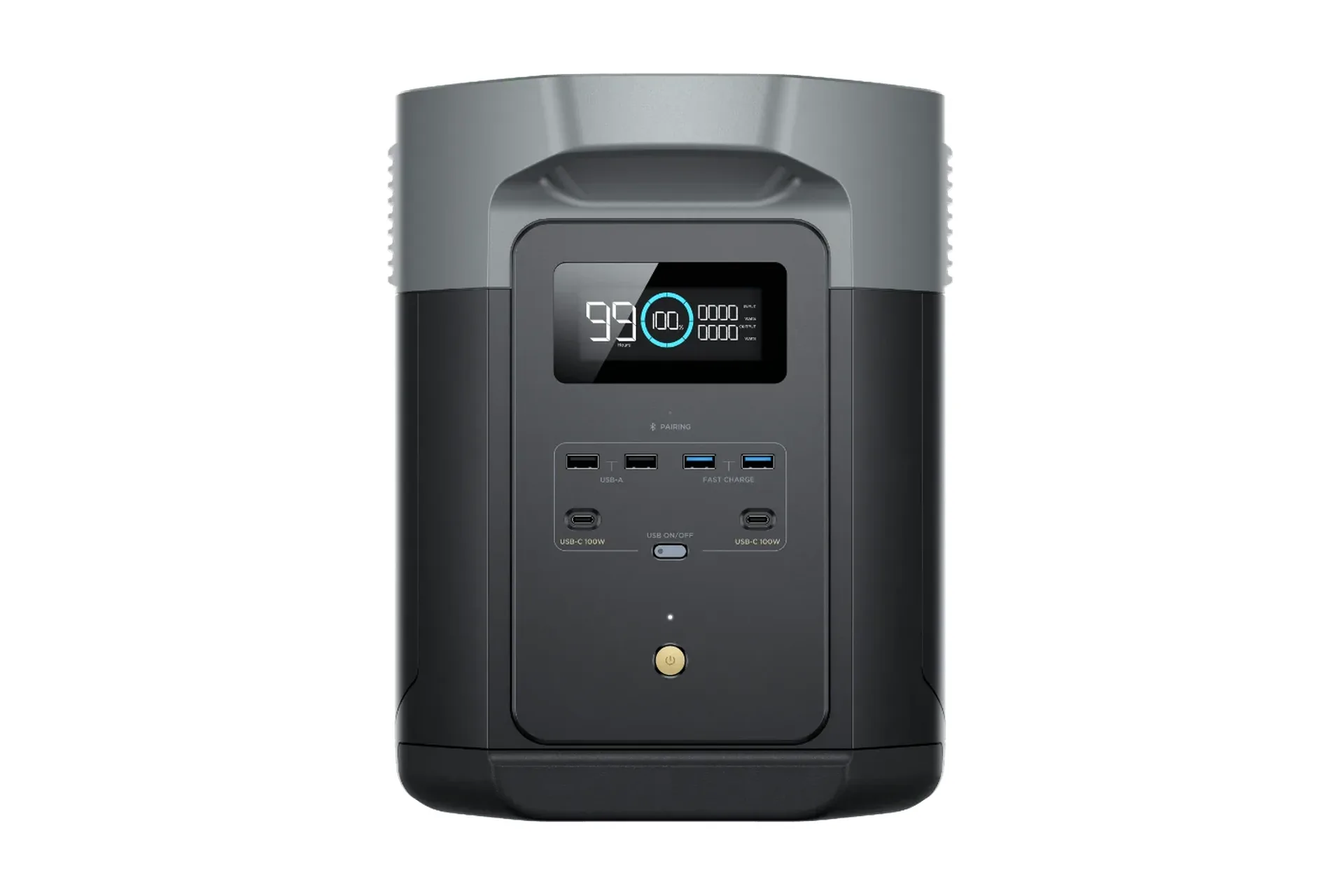
- EcoFlow Delta 2 (1,024Wh, ~870Wh usable): about 14–21 hours. Most of a day.
- BLUETTI Elite 100 V2 (1,024Wh, ~870Wh usable): about 14–21 hours. Same capacity math as the Delta 2.
- Anker Solix C1000 Gen 2 (1,024Wh, ~870Wh usable): about 14–21 hours — the same capacity math as the Delta 2 and the Elite 100 V2.
- Jackery Explorer 1000 v2 (1,070Wh, ~910Wh usable): about 15–22 hours. Most of a day, the best of the 1kWh class on paper.
- EcoFlow Delta 2 Max (2,048Wh, ~1,741Wh usable): about 28–42 hours. A day and a half, approaching two days with an efficient fridge.
- BLUETTI Apex 200 (2,560Wh, ~2,176Wh usable): about 35–52 hours. Two days or more.
Two patterns stand out. First, capacity class matters far more than brand: all four 1kWh stations land within an hour or two of each other. Second, doubling capacity a little more than doubles your safety margin, because the hours beyond the first day are the ones where food actually spoils. If you are sizing from scratch, our power station size calculator lets you add the fridge alongside lights, a router, and medical devices to get the full picture.
Picks by scenario
These picks are based on manufacturer specifications, since our test lab is not running yet. Match the station to the outage you are actually preparing for — not the worst one you can imagine.
Short outage (a few hours to overnight): EcoFlow River 2 Pro
Most outages end within a few hours, and the River 2 Pro covers that with room to spare: 768Wh LiFePO4, 800W output to absorb compressor surge, and 17 lbs — light enough to carry to the kitchen without planning the trip. Its ~10–16 fridge hours also leave capacity for a router and phone charging if the outage stretches into the night. The limit is real, though: if your outages regularly run past 12 hours, buy the next class up instead. Around $300 on sale. Check price
Overnight to a full day: EcoFlow Delta 2
The 1kWh class is the sweet spot for fridge backup, and the Delta 2 is its benchmark: 1,024Wh, 1,800W output (surge is a non-issue), and an ~80-minute full AC recharge, so if power flickers back for even an hour you can refill completely. Expect most of a day of fridge runtime. The BLUETTI Elite 100 V2 matches its capacity and adds a 1,000W solar ceiling; the Anker Solix C1000 Gen 2 trades expansion for the fastest recharge here, about 49 minutes on AC; the Jackery Explorer 1000 v2 is the lightest and simplest of the group. Any of the four serves a fridge well — choose on price and the solar headroom below. Around $400 on sale. Check price
Multi-day outage: EcoFlow Delta 2 Max
Once you are planning for day two, capacity and solar input both jump. The Delta 2 Max carries 2,048Wh (expandable to 6,144Wh), 2,400W output, and 1,000W max solar input — enough to accept a serious panel array and genuinely recharge while the fridge runs. On battery alone it buys roughly a day and a half to two days; paired with panels, it can run a fridge indefinitely in decent weather. At 50 lbs it is a two-hand lift, but it lives in one place during an outage, so weight matters less than at a campsite. Around $1,000–1,200 on sale. Check price
The longest outages and whole-home ambitions: BLUETTI Apex 200
The Apex 200 is the step up when a fridge is only the first load on your list: 2,560Wh, 3,200W output, expandability, and a 3,000W max solar input per BLUETTI’s launch materials — roof-array territory. For the fridge alone it delivers two days or more. It is overkill for refrigerator backup by itself, but if your outage plan also includes a freezer, a sump pump, or work-from-home power, this is the class to shop. $1,099 launch / $1,399 regular. Check price
If your backup plan extends well beyond the fridge, our guide to the best portable power station for home backup covers the whole-home picture, and the overall rankings live in our best portable power station roundup.
Keeping food safe during an outage
The station buys time; your habits decide how much of that time the food survives.
- The 40°F rule. Refrigerated food is safe while the fridge stays at or below 40°F. Perishables held above 40°F for more than about two hours should be discarded — when in doubt, throw it out.
- Keep the door closed. An unopened refrigerator holds safe temperatures for roughly four hours on its own; every opening spends that reserve. Decide what you need before you open the door, and keep a cooler for drinks and snacks so the fridge stays shut.
- Connect the station early. Plug the fridge into the station at the start of the outage, not after the internal temperature has already climbed. A fridge that starts cold asks far less of the battery.
- Freeze water bottles in advance. They turn your fridge into a better icebox, slow the temperature rise between compressor cycles, and give the station an easier load.
- Use a fridge thermometer. A $10 thermometer removes the guessing. If it reads above 40°F and you do not know for how long, the food goes.
Solar pairing for multi-day outages
Beyond about two days, no reasonably priced station carries a fridge on battery alone — the answer is refilling by day. The site-wide math: panel watts × peak sun hours × 0.75 real-world factor = watt-hours recovered per day. Your fridge needs roughly 1–1.5 kWh per day, so the array has to beat that number.
- 400W of panels × 5 sun hours × 0.75 ≈ 1,500Wh/day. That covers a fridge’s daily appetite with a small surplus — the minimum sensible setup for indefinite fridge backup. The Delta 2 (500W max solar input) accepts a 400W panel at full value.
- 800W of panels × 5 sun hours × 0.75 ≈ 3,000Wh/day. Fridge plus lights, router, and device charging, with real margin for a cloudy day. This needs a station with the input to match — the Delta 2 Max or Elite 100 V2, both rated at 1,000W max solar input.
A few honest caveats. Winter sun hours run shorter than summer ones, and a storm long enough to knock out power often brings the clouds that cut solar output — plan your battery capacity for the cloudy days and treat solar as the range extender, not the sole supply. Keep panels somewhere you can deploy them fast, and know your station’s max solar input before buying panels: watts beyond the cap are wasted money. Our guides hub has the deeper solar-sizing walkthroughs if you want to model your own roof, yard, or balcony.
Frequently asked questions
What size portable power station do I need for a refrigerator?
For a few hours of backup, 768Wh is enough. For a full day, buy the 1kWh class. For multi-day outages, look at 2kWh or more, ideally paired with solar panels. Whatever the class, confirm the inverter outputs at least 800W so compressor startup surge does not trip it.
Why does my fridge trip a small power station even though it only draws 150W?
Startup surge. The compressor briefly pulls 2–3× its running watts when it kicks on. A station with too little inverter headroom faults on that spike even with a full battery.
Can a portable power station run a fridge and a freezer at the same time?
Yes, with a 2kWh-class station: combined, the pair averages roughly 2–2.5 kWh/day, and their surges rarely peak simultaneously. A 1kWh station can do it for part of a day, but the margin gets thin fast.
Is it bad to leave a power station plugged into the fridge all the time?
Many stations support pass-through charging, but running one as a permanent UPS adds charge cycles and heat. For outage readiness, keep the station charged to 80–100%, stored nearby, and plug the fridge in when the power fails — lithium iron phosphate batteries hold their charge well in storage.
How long will food last if the station runs out?
An unopened fridge holds safe temperatures for about four hours after power stops; a freezer for about 24–48 hours depending on how full it is. That is the buffer your station is extending — size the station so you never have to test it.
Leave a Reply