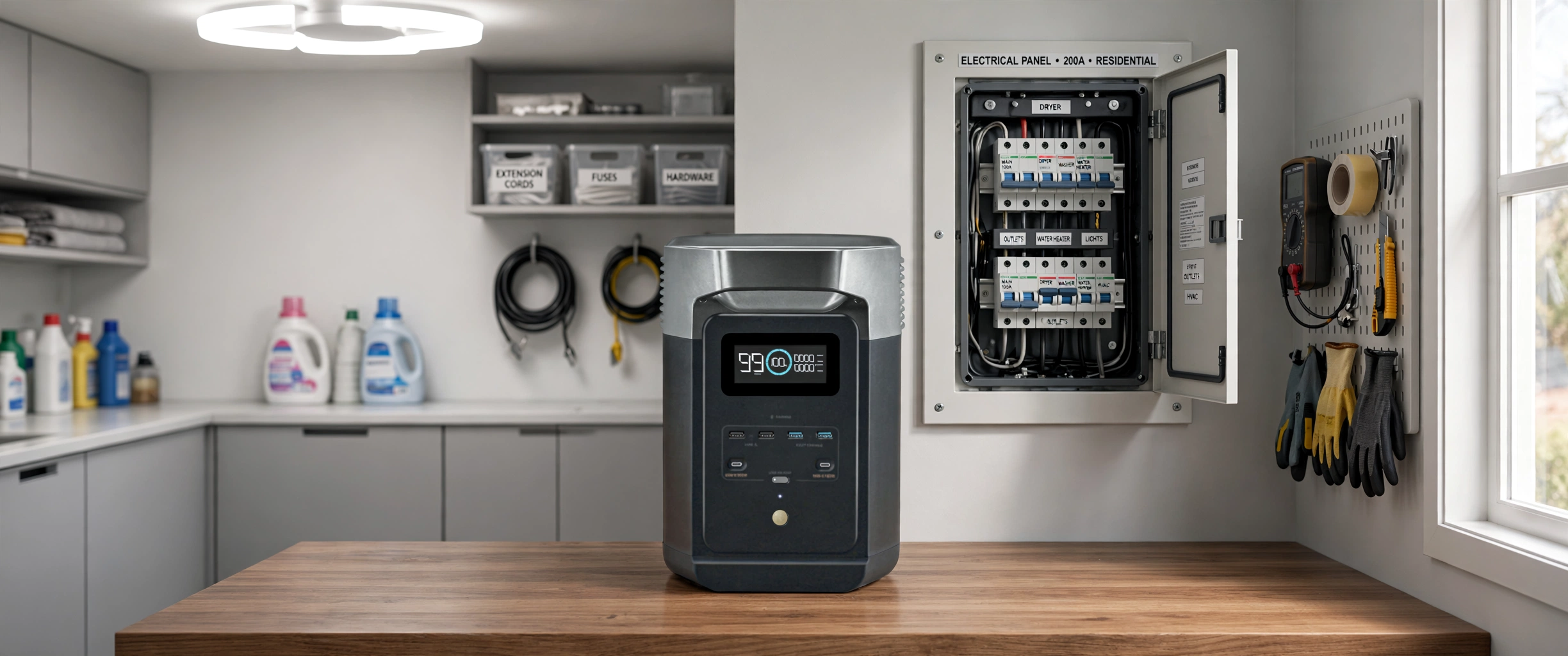
When the grid goes down, a portable power station is the quiet, fume-free alternative to a gas generator — no fuel storage, no pull cord, no carbon monoxide risk. But “home backup” covers everything from keeping phones charged to running a refrigerator through a multi-day outage, and the right station depends entirely on which of those you need. This guide maps capacity to real outage scenarios, with spec-based picks at each tier.
- What a power station can (and can’t) do
- Capacity tiers: match the station to the outage
- UPS mode: the seamless switchover
- Expandability for longer outages
- Spec-based picks by tier
- Recharging during the outage
- Frequently asked questions
What a power station can (and can’t) do
A portable power station can run anything a wall outlet can, up to its output limit. Realistic home backup loads:
- Easily handled: phones, laptops, LED lights, WiFi router, CPAP machine, 12V fridge, fans
- Needs a 1000Wh+ station: full-size refrigerator, TV, microwave (short bursts), sump pump (see our sump pump guide for the caveats)
- Needs a 2000Wh+ station: refrigerator + freezer together, window AC (small), electric kettle
- Beyond portable stations: central AC, electric water heater, electric stove, whole-house HVAC — these need 5kW+ sustained, which means a permanently installed battery system or generator
The honest boundary: portable stations cover essential circuits — food safety, medical devices, communications, and comfort — not whole-house normalcy. Anyone promising whole-home backup from a single portable unit is selling something.
Capacity tiers: match the station to the outage
| Tier | Capacity | Covers | Typical outage |
|---|---|---|---|
| Essentials | 500–768Wh | Phones, lights, router, laptop | 4–8 hours |
| Refrigerator | 1,000–1,500Wh | Above + full-size fridge | 8–16 hours |
| Extended | 2,000–3,000Wh | Above + freezer, TV, fans | 1–2 days |
| Multi-day | 3,000Wh+ or expandable | Above, sustained | 2+ days (with solar) |
Most buyers land in the Refrigerator tier — a 1000Wh station is the price/performance sweet spot for the outages most households actually experience (4–12 hours). The Extended tier makes sense if your area sees multi-day outages from storms or wildfire shutoffs.
UPS mode: the seamless switchover
The best home-backup setup is not unboxing the station when the lights go out — it is leaving it plugged in as a UPS (uninterruptible power supply). In UPS mode, the station sits between the wall outlet and your critical devices. Grid power flows through; when it fails, the station’s battery takes over.
What matters is switchover speed:
- Under 20ms: computers, routers, and CPAP machines ride through without rebooting
- 20–50ms: fine for fridges and most appliances, may reboot sensitive electronics
- Seconds: not a real UPS — the load drops and restarts
Check the spec sheet for the exact switchover time; manufacturers that offer true UPS mode advertise the number. Keep the station at 80–100% charge in UPS duty (unlike long-term storage, readiness matters more than cell longevity here).
Expandability for longer outages
Several current stations accept expansion batteries that stack capacity without buying a second full unit:
- EcoFlow Delta 2 Max: expands to 6,144Wh with two extra batteries
- BLUETTI modular systems (AC300/AC500): scale to 12–18kWh with stacked batteries
- Jackery 2000 Plus: expandable via PackPlus batteries
Expansion is the cost-effective path to multi-day coverage: buy the base unit now, add batteries later if outages prove longer than expected. It also beats buying an oversized station upfront — batteries are the expensive part, and you only pay for what you need.
Spec-based picks by tier
Based on manufacturer specifications, not lab testing yet. Each pick is the value leader in its tier at typical sale pricing.
Refrigerator tier: EcoFlow Delta 2
The EcoFlow Delta 2 Check price (1,024Wh, 1,800W output) handles a full-size fridge (~8 hours), phones, lights, and a router through a typical outage. The ~80-minute wall recharge means brief grid returns refill it fast. Usually the cheapest reputable 1kWh unit on sale.
Extended tier: EcoFlow Delta 2 Max
The EcoFlow Delta 2 Max Check price (2,048Wh, 2,400W output, expandable to 6,144Wh) is the home-backup workhorse: fridge + freezer + comfort loads for a day or more, 2,400W clears virtually any appliance surge, and expansion batteries extend it to multi-day territory.
Solar-first alternative: BLUETTI Elite 100 V2
The BLUETTI Elite 100 V2 Check price (1,024Wh, 1,800W output, 1,000W max solar) is the pick if your outage plan centers on solar refills: double the Delta 2’s solar input means daytime panels meaningfully extend runtime, potentially indefinitely in good sun.
For outage-specific planning — what to prioritize in the first hour, how to stretch every watt — see our companion guide on the best stations for power outages.
Recharging during the outage
A station without a recharge plan is a countdown timer. Options during an extended outage:
- Solar panels: the only renewable option. 400W of panels in good sun refills a 1000Wh station in ~3 hours. Even 200W meaningfully extends runtime.
- Car charging: slow (~100W via 12V socket) but works if you can run the engine periodically. An alternator charger (up to 800W) is far faster.
- Generator top-up: a small inverter generator refills a 1000Wh station in about an hour — the hybrid approach many storm veterans use: generator for bulk charging, station for quiet nighttime power.
- Public charging: libraries, community centers, and stores with power — a fast-charging station (80 minutes to full) makes opportunistic top-ups practical.
Prioritizing loads when capacity is limited
When the outage outlasts your station, triage matters. A priority order that works for most households:
- Medical devices (CPAP, oxygen concentrator, powered wheelchair charger) — non-negotiable, run these first
- Refrigerator — food safety; 4 hours unopened is the safe limit
- Communications (phones, router) — low draw, high value; a phone charger sips power
- Lighting — LED lights draw almost nothing; keep one or two rooms lit
- Comfort (fans, TV, laptop) — run when capacity allows, cut first when it does not
- Freezer — a full freezer holds for 48 hours unopened; it can wait
The discipline version: run the fridge for 2 hours, then unplug it and run comfort loads for 2 hours, then back to the fridge. Cycling loads manually stretches a 1000Wh station across a 16-hour outage that would drain it in 8 hours of continuous fridge duty. A $15 plug-in timer automates the cycling if you want to set and forget.
Frequently asked questions
Can a portable station power my whole house?
No — not through the breaker panel without a transfer switch and a very large system. Portable stations power individual devices via their outlets. Whole-house backup needs a permanently installed battery or generator.
How long will 2000Wh last in an outage?
It depends entirely on load. Fridge-only (~150W): ~11 hours of compressor time, often 16+ wall-clock hours with cycling. Fridge + lights + phones + laptop: roughly a full day. Add a TV and fans: 12–16 hours.
Is a power station better than a generator for home backup?
Different tools. Stations: silent, indoor-safe, instant-on, no fuel — ideal for short outages and nighttime. Generators: far more energy per dollar, run for days on fuel — better for extended outages. Many households eventually own both.
Do I need an electrician?
Not for plug-in use — that is the point of portable stations. You only need an electrician if you want a transfer switch wired to your breaker panel, which is a permanent-installation project beyond portable units.
Leave a Reply