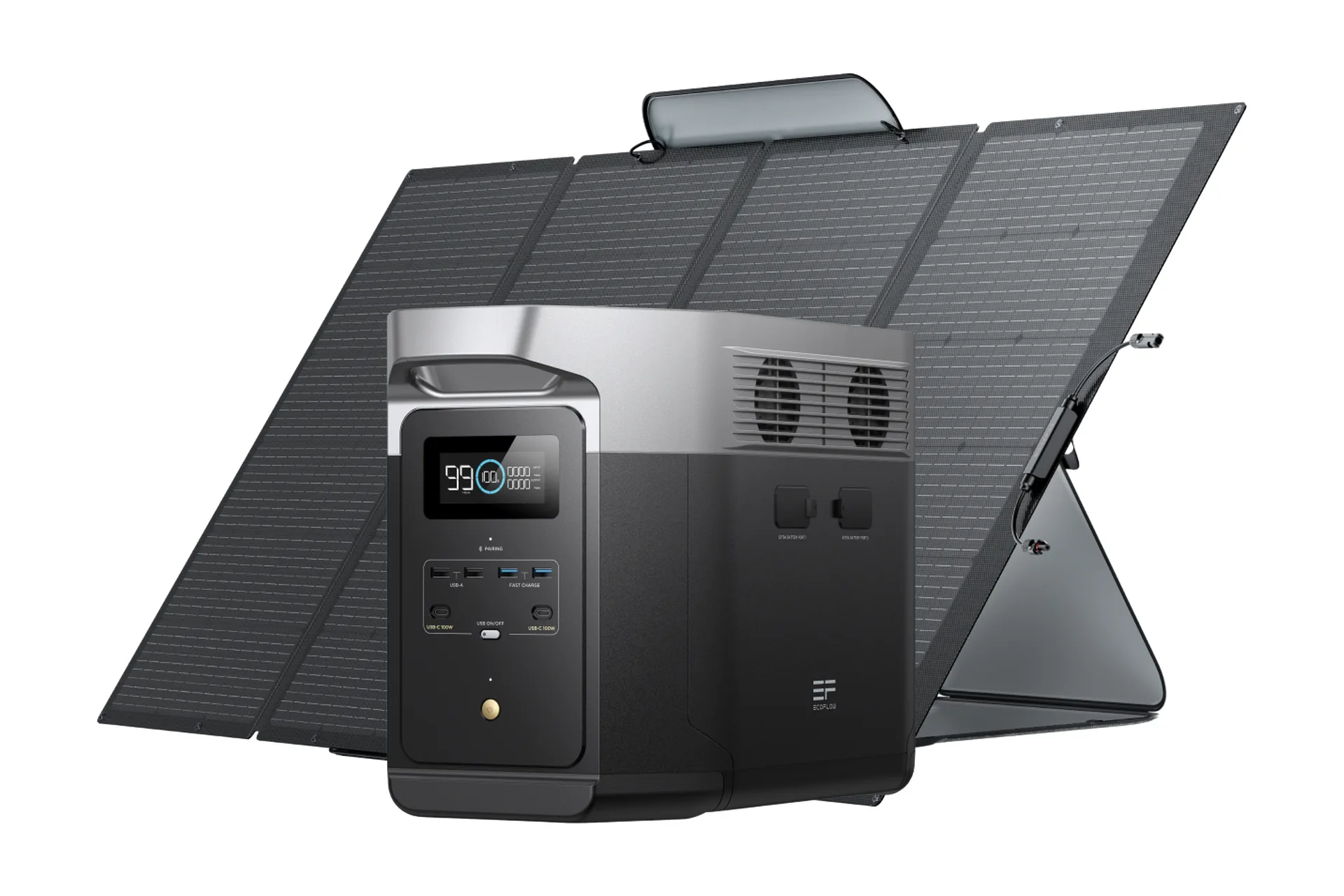
Buy the station first and the panel second, and you will probably buy the wrong panel. “Portable power station with solar panel” sounds like one product, but it is really a pairing — and the pairing is governed by a single spec most shoppers never read: the station’s maximum solar input. Get it right and your station refills in a few hours of sun; get it wrong and you have paid for panel watts the station physically cannot accept. This guide lays out the one rule, a pairing table for every station in our catalog with realistic recharge times, the connector and voltage basics, and when to buy the bundle versus the pieces. It complements our best solar generator rankings, which score the stations themselves.
- The one rule: respect max solar input
- The pairing table: all seven stations
- Voltage and connectors: MC4, series, parallel
- Portable vs rigid panels
- Worked example: Delta 2 + 400W
- Bundle vs buying separately
- Frequently asked questions
GadgetPreview is reader-supported. When you buy through links on our site, we may earn an affiliate commission.
The one rule: respect max solar input
Never exceed the station’s max solar input — and understand what “exceed” really costs. The station’s charge controller accepts up to its rated watts and no more. A panel array larger than the cap does not damage a modern station; the controller simply clips the excess. But those clipped watts are money you spent on panel you cannot use, plus weight you carry for nothing.
Near the cap is fine — in fact it is the goal. Panels rarely deliver their rated watts in the field (the site-wide planning rule is panel watts × peak sun hours × 0.75 real-world factor = watt-hours recovered per day), so an array rated exactly at the cap delivers about three-quarters of the cap in real sun, and the station charges as fast as it safely can. Double the cap is wasted money: a 1,000W array on a 500W-input station behaves like a 500W array on every day that matters.
So the buying sequence is: read the station’s max solar input, choose a panel (or panel set) rated at or just under it, and check the pairing against our power station size calculator if you are also deciding capacity. If you have not picked a station yet, start with what size portable power station you need — then come back here and pair it.
The pairing table: all seven stations
Recharge times below assume a clear day and the 0.75 real-world factor applied to the panel, filling the station from empty. “Peak sun hours” is the unit that matters — a summer day commonly offers 4–6 of them, so anything at or under ~4 peak sun hours is a comfortable one-day refill. These pairings are based on manufacturer specifications, since our test lab is not running yet.
| Station | Max solar input | Sensible panel pairing | Sunny-day full recharge |
|---|---|---|---|
| EcoFlow River 2 Pro (768Wh) | 220W | EcoFlow 220W portable | ~5 peak sun hours |
| EcoFlow Delta 2 (1,024Wh) | 500W | EcoFlow 400W portable | ~3.5 peak sun hours |
| BLUETTI Elite 100 V2 (1,024Wh) | 1,000W | BLUETTI PV350 (350W) — room to add a second panel | ~4 peak sun hours |
| Anker Solix C1000 Gen 2 (1,024Wh) | 600W | Anker Solix PS400 (400W) | ~3.5 peak sun hours |
| Jackery Explorer 1000 v2 (1,070Wh) | 400W | 2× Jackery SolarSaga 200 | ~3.5–4 peak sun hours |
| EcoFlow Delta 2 Max (2,048Wh) | 1,000W | 2× EcoFlow 400W portable (800W total) | ~3.5 peak sun hours |
| BLUETTI Apex 200 (2,560Wh) | 3,000W | 2× 400W-class portables (800W) for field use; the huge cap is really for rigid home arrays | ~4–4.5 peak sun hours |
Reading the table: the River 2 Pro is the only station here that needs most of a sunny day to refill, because its small input cap matches its small battery. The 1kWh class refills in a morning-to-early-afternoon window with a single large portable panel. And the two big stations only hit their fast times with two panels — a single 400W panel on a Delta 2 Max needs roughly 7 peak sun hours, more than most days offer. Capacity and panel count have to scale together.
Quick check prices for the most-paired stations: the Delta 2 runs around $400 on sale Check price, the Elite 100 V2 around $430 Check price, the Anker Solix C1000 Gen 2 around $530–550 Check price, and the Delta 2 Max around $1,000–1,200 on sale Check price.
Voltage and connectors: MC4, series, parallel
Watts are only half the pairing. The station also has a solar input voltage window — a minimum and maximum voltage the charge controller accepts — and your panel setup has to land inside it. We are keeping this general on purpose: the exact window differs by model, so check your station’s manual rather than any article’s figures, ours included.
Connectors. Most portable panels terminate in MC4 connectors — the weatherproof, locking standard from rooftop solar — and stations typically include or require an MC4-to-station-input adapter cable. Same-brand pairings (EcoFlow panel to EcoFlow station, SolarSaga to Jackery) usually include everything in the box; cross-brand pairings work fine electrically, but budget for the adapter cable and confirm it is the right one before a trip, not during one.
Series vs parallel. Wire two panels in series and their voltages add while current stays the same; wire them in parallel and current adds while voltage stays the same. Series is the common choice for reaching a station’s minimum voltage efficiently and keeping cable losses low, but it raises total voltage — two panels in series can exceed a small station’s maximum input voltage even when the combined watts look safe. Parallel keeps voltage at one panel’s level and suits stations with low voltage ceilings, at the cost of thicker cable runs. The rule of thumb: do the voltage math from the panels’ rated open-circuit voltage before wiring anything, and stay inside the station’s printed window with margin.
Portable vs rigid panels
Portable (folding) panels — the EcoFlow 400W and 220W, BLUETTI PV350/PV200/PV120, Jackery SolarSaga line, Anker Solix PS400 — fold into a carry case, prop up on kickstands, and reposition in seconds. They cost more per watt and convert slightly less efficiently than rigid panels, and in exchange they go anywhere: campsite, balcony, backyard during an outage. Everything in the pairing table above is a portable-panel pairing.
Rigid panels are standard rooftop-style glass panels: cheapest per watt, most durable, and essentially permanent once mounted. They make sense when the station lives at home — a Delta 2 Max or Apex 200 parked under a roof array turns into a genuine solar generator for home use, which we cover in our guide to a solar generator for home setups. The catch is that a rigid array is infrastructure: mounting, wiring, and a fixed sun exposure you cannot chase.
Many owners end up with both over time — rigid at home for outages, a folding panel for the road. The field version of that lifestyle is in our solar generator for camping guide.
Worked example: Delta 2 + 400W
Here is the full arithmetic for the most popular pairing in the table, so you can audit any other combination the same way.
- Station: EcoFlow Delta 2, 1,024Wh, max solar input 500W.
- Panel: EcoFlow 400W portable — rated under the 500W cap, so nothing is clipped.
- Real-world delivery: 400W × 0.75 = about 300W in good sun.
- Full recharge from empty: 1,024Wh ÷ 300W ≈ 3.4 hours — call it ~3.5 peak sun hours.
- Daily harvest on a 5-peak-sun-hour day: 400 × 5 × 0.75 = 1,500Wh — the full battery, plus about half again, which is why this pairing also sustains daily loads while it charges.
Now change one variable and watch the rule bite: swap in two 400W panels (800W rated) and the Delta 2 still accepts only 500W. Recharge improves modestly on imperfect days — the oversized array holds near-cap output through morning and evening angles — but on a clear midday it clips to the same ceiling. That headroom trick is legitimate for shoulder-season sun; paying double purely for midday speed is not.
Bundle vs buying separately
Bundles (station + panel sold together, Jackery’s Solar Generator kits being the archetype) guarantee matched connectors, correct adapter cables, and a pairing the manufacturer has already sanity-checked against the input cap. They frequently go on sale as a unit, and for a first purchase the zero-research convenience is real value.
Buying separately wins when the math matters more than the convenience: you can pair any brand’s panel with any station, catch the station and the panel on separate sales, and — most importantly — size the panel to your actual use instead of the bundle’s marketing tier. Bundles tend to under-panel big stations (a 2kWh station with a single 200W panel takes days to refill) and occasionally over-panel small ones. Run the pairing table numbers on any bundle before buying: if the panel watts sit far below the station’s cap and the battery is large, that bundle charges slowly no matter how good the discount looks.
Either way, verify three things before checkout: panel watts at or under the input cap, total series voltage inside the station’s window, and the adapter cable included or added to the cart. More pairing walkthroughs and seasonal buying advice live in our guides hub.
Frequently asked questions
Can I use a bigger solar panel than my station’s max solar input?
You can connect it, and a modern station will simply clip the excess — but the watts above the cap are wasted money and weight. Slight oversizing helps on cloudy days and at low sun angles; doubling the cap does not double anything.
How many watts of solar panel do I need for a 1,000Wh station?
For a same-day refill, 350–400W is the sweet spot: about 3.5 peak sun hours to full. A 200W panel works but needs most of a sunny day, and anything under 200W is a multi-day proposition for a battery that size.
Can I mix panel brands with a power station?
Yes, electrically — solar output is solar output. You will usually need the right MC4 adapter cable for the station’s input, and you must respect the station’s wattage cap and voltage window. Same-brand pairings just remove the cable guesswork.
Is it better to wire two panels in series or parallel?
Series adds voltage and is the default for most setups; parallel adds current and keeps voltage low. The deciding factor is your station’s input voltage window — add up the panels’ open-circuit voltage in series and make sure the total stays inside it.
Do portable panels charge on cloudy days?
Yes, but slowly — heavy overcast can cut output to 10–25% of rated watts. The 0.75 factor in our math is a clear-day planning figure, not a guarantee; size your battery for the grey days and treat solar as the refill, not the foundation.
Leave a Reply